Philatelic of Birds (English subtitle)|Regions Index
小菜鳥的博客 Philatelic of Birds (Bilingual subtitles) |文章目錄ContentSoapbox
Due to heavy reconstruction of this webpage, this blog is temporary suspended to renew in this summer, it will be updated again after late-autumn, thank you for your visits in these 9 years.

Showing posts with label Asia. Show all posts

29 April 2017

⭕️Birds of prey, Singapore

From left to right :
White-bellied Sea Eagle (白腹海鵰) ; Brahminy Kite (栗鳶)
Black-winged Kite (黑翅鳶) ; Changeable Hawk Eagle (鳳頭鷹雕)
Singapore (2016)

21st September, 2016. Toa Payoh Central

Changeable Hawk Eagle is well established in Singapore. Its name reflects its occurrence in two different colour morphs – dark and light. It is a mid-sized raptor and a forest edge bird, with typically broad wings and a relatively small wingspan. It feeds on small- to large-sized birds, mammals – up to the size of small macaques, and reptiles.

White-bellied Sea Eagle is one of Singapore’s largest native raptor. It is seen frequently gliding over reservoirs and woodland areas and adult birds can be identified easily by their pure white lower bodies. It hunts fish, sea snakes, terrapins, frogs, rats and fruit bats.

Brahminy Kite is a highly adaptable raptor. It is common in Singapore and distinguished easily by a contrasting combination of an auburn-brown body with a grey-white head. Unlike other kites, it has a round, instead of a forked, tail. It feeds mostly on garbage from the surface of the sea. It also eats small crustaceans, frogs, rats, shellfish and fish.

Black-winged Kite is a medium-small raptor found mostly in grassland areas. It can be recognised by its red eyes and its light grey plumage that has a black patch on each wing. It hunts usually from a perch but is also capable of hovering like the kestrel species. In this, it is unique among kite species. It feeds mostly on rodents and insects.

From left to right :
White-bellied Sea Eagle (白腹海鵰) ; Brahminy Kite (栗鳶)
Black-winged Kite (黑翅鳶) ; Changeable Hawk Eagle (鳳頭鷹雕)
Singapore (2016)

21st September, 2016. Philatelic Bureau

22 April 2017

⭕️Red-billed Leiothrix

Red-billed Leiothrix (紅嘴相思鳥)
China (2016)

9th August, 2016. Longdong, Guangzhou

Red-billed Leiothrix is native to the Indian subcontinent. Adults have bright red bills and a dull yellow ring around their eyes. Their backs are dull olive green, and they have a bright yellow-orange throat with a yellow chin; females are somewhat duller than males, and juveniles have black bills. It has also been introduced in various parts of the world, with small populations of escapees having existed in Japan since the 1980s.

The species usually found in India, Bhutan, Nepal, Burma and parts of Tibet. This species is a bird of the hill forests, found in every type of jungle though it prefers pine forests with bushes. It has also been found at elevations ranging from near sea level to about 7,500 feet.

The species was introduced to the Hawaiian Islands in 1918 and spread to all the forested islands except Lanai. Its population on Oahu crashed in the 1960s and it disappeared from Kauai, but is now common and increasing on Oahu. The leiothrix was released in Western Australia but it failed to become established. This species was also introduced in Great Britain but permanent establishment was unsuccessful. It was introduced to France, where it is now established in several areas, and Catalonia where it is increasing and spreading from the Collserola Park.

11 February 2017

National bird of Mongolia

Saker Falcon (獵鷹)
Mongolia (2013)

11th July, 2016. Ulaanbaatar

Saker Falcon is a large hierofalcon, larger than the lanner falcon and almost as large as gyrfalcon at 47–55cm length with a wingspan of 105–129cm. Its broad blunt wings give it a shadow similar to Gyrfalcon, but its plumage is more similar to a lanner falcon's.

Saker Falcons have brown upperbellies and contrasting grey flight feathers. The head and underparts are paler brown, with streaking from the breast down. Males (called sakrets in falconry) and females are similar, as are young birds, although these tend to be a duller brown. The call is a sharp kiy-ee.

Adults can be distinguished from the similar lanner falcon since the lanner is blue-grey above with a reddish back to the head. However, juveniles of the two species can be very similar although the saker falcon always has a uniformly buff top of the head with dark streaks, and a less clear pattern on the sides of the head.

A further complication is that some Asian birds have grey barred upperparts; these must be separated from lanner on size, structure, and a weaker moustache stripe. Saker falcons at the northeast edge of the range in the Altai Mountains are slightly larger, and darker and more heavily spotted on the underparts than other populations. These, known as the Altai falcon, have been treated in the past either as a distinct species "Falco altaicus" or as a hybrid between saker falcon and gyrfalcon, but modern opinion is to tentatively treat it as a form of saker falcon, until comprehensive studies of its population genetics and ecology are available.

This species belongs to the close-knit hierofalcon complex. In this group, there is ample evidence for rampant hybridization and incomplete lineage sorting which confounds analyses of DNA sequence data to a massive extent; molecular studies with small sample sizes can simply not be expected to yield reliable conclusions in the entire hierofalcon group. The radiation of the entire living diversity of hierofalcons seems to have taken place in the Eemian interglacial at the start of the Late Pleistocene, a mere 130,000–115,000 years ago; the saker falcon represents a lineage that expanded out of northeastern Africa into the interior of southeastern Europe and Asia, by way of the eastern Mediterranean region.

28 January 2017

⭕️Nature conservation in Japan

From left to right :
Bonin Honeyeater (笠原吸蜜鳥) ; Ryukyu Robin (琉球歌鴝)
Short-tailed Albatross (短尾信天翁) ; Red-crowned Crane (丹頂鶴)
Japan (1975, 1976)

4th May, 2011. Tōro, Shibecha

Japanese archipelago stretches from the subtropical to subarctic zones running parallel to the eastern rim of the Eurasian Continent consists of four main islands and more than 3,900 smaller islands whose area cover almost 378 thousand square kilometers.

Rapid economic development which started in the 1960's has changed the social and economical structure and life style in Japan, particularly in Tokyo and other big cities. Huge industrial complexes have been developed and rapidly urbanized suburban areas.

Still, forest areas cover 67 percent of Japan's total land area and agricultural lands 14 percent. Because of its mountainous topographical nature, a large part of Japan is still decorated with beautiful primitive and secondary forests. Brown bears, black bears, and Japanese deer trot in forests, and golden eagles, cranes and herons glide in blue sky.

31 December 2016

⭕️Endangered birds of Japan

First line :
Peregrine Falcon (擬游隼) ; Crested Serpent Eagle (大冠鷲)
White-backed Woodpecker (大赤啄木) ; Marsh Grassbird (斑背大尾鶯)

Second line :
Blakiston's Fish Owl (毛腳漁鴞) ; Cackling Goose (小加拿大雁)
Third line :
Okinawa Rail (沖繩秧雞) ; Japanese Wood Pigeon (黑林鴿)
Nordmann's Greenshank (諾氏青足鷸) ; Okinawa Woodpecker (野口啄木鳥)

Ireland (2014)
25th May, 2014. Ōhara, Iriomote

Japan is located in the northwest Pacific Ocean. Being latitudinally long, the island chain covers a wide climatic range; from the boreal to the sub-tropical climate zone. There are also two ecological lines which divide the countries flora and fauna. These are Blakiston's Line (between Hokkaido and Honshu) and the Watase's Line (southern Japan). Because of this unusual ecological background, Japan's avifauna is incredibly rich. More than 600 species have been recorded to date. Most of them are migratory (more than 60%) whilst approximately 60 species are either endemic or sub-regional endemic, including the internationally famous Okinawa Rail, Blakiston's Fish-owl, Japanese Murrelet, Red-crowned Crane, Pryer's Woodpecker and Lidth's Jay.

Birding in Japan is increasingly popular. The largest nature conservation NGO, the Wild Bird Society of Japan, has more than 53,000 members and there are more birders who do not belong to the WBS-J. Twitching is becoming more and more common. People can get to rare birds within a few hours of their discovery because of the development of the internet and mobile telephones.

19 November 2016

⭕️ Thailand - North Korea diplomatic relations 40 years

 
Northern Goshawk  (蒼鷹) ; Siamese Fireback (戴氏鷴)
North Korea (2015)
30th May, 2016. Pyongyang

Northern Goshawk  (蒼鷹) ; Siamese Fireback (戴氏鷴)
Thailand (2015)
 
28th August, 2015. Bangkok

Siamese fireback also known as Diard's fireback is a fairly large, approximately 80 cm long, pheasant. The male has a grey plumage with an extensive red facial skin, crimson legs and feet, ornamental black crest feathers, reddish brown iris and long curved blackish tail. The female is a brown bird with blackish wing and tail feathers.

The Siamese fireback is distributed to the lowland and evergreen forests of Cambodia, Laos, Thailand and Vietnam in Southeast Asia. This species is also designated as the national bird of Thailand. The female usually lays between four to eight rosy eggs.

The scientific name commemorates the French naturalist Pierre-Médard Diard.

Northern Goshawk is a medium-large raptor in the family Accipitridae, which also includes other diurnal raptors, such as eagles, buzzards and harriers. As a species in the Accipiter genus, the goshawk is often considered a true "hawk". The scientific name is Latin; Accipiter is "hawk", from accipere, "to grasp", and gentilis is "noble" or "gentle" because in the Middle Ages only the nobility were permitted to fly goshawks for falconry.

It is a widespread species that inhabits the temperate parts of the Northern Hemisphere. It is the only species in the Accipiter genus found in both Eurasia and North America. With the exception of Asia, it is the only species of "goshawk" in its range and it is thus often referred to, both officially and unofficially, as simply the "goshawk". It is mainly resident, but birds from colder regions migrate south for the winter. In North America, migratory goshawks are often seen migrating south along mountain ridge tops in September and October.

This species was first described by Linnaeus in his Systema naturae in 1758 under its current scientific name.


12 November 2016

⭕️Philately Week 2008

From left to right :
Snowy Plover (小環頸鴴) ; Little Egret (小白鷺)
Japan (2008)
17th May, 2016. Miyagi Sendai

Watanabe Shotei was a versatile artist and artisan of the Japanese Meiji era. At an early age he had the possibility to exhibit Japan's arts and crafts as a team member of Shibata Zeshin for the Paris World Exhibition of 1878. Later he travelled to Europe and the United States to study Western art and to exhibit Japanese arts and crafts outside of Japan.

Watanabe Shotei studied painting. Still at a young age he began to work for Shibata Zeshin who at that time was one of Japan's most renowned painters, lacquer artists and printmakers. Zeshin Shibata was selected to represent Japan at the international world exhibitions in Vienna in 1875, in Philadelphia in 1876 and in Paris in 1878.

Watanabe Shotei received the opportunity to accompany Zeshin Shibata in 1878 for the Paris World Exhibition. This lead him to further travels to the United States and to an extended stay in Paris to study Western art.

Back in Japan Shotei Watanabe followed the career scheme of Shibata Zeshin by not concentrating on one art form, but being active in a number of different art and artisan fields - printmaking, painting and making designs for Japanese cloisonné.

Also in printmaking he covered a wide field - from kuchi-e to kacho-e. Watanabe's printmaking style varies from the minimalistic approach rooted in Japanese and Chinese painting to a style that reminds us of the coming shin hanga art movement promoted by the Tokyo publisher Watanabe Shozaburo.

When the art dealer and collector Robert O. Muller passed away in 2003, he left the greatest and in the view of many art collectors and dealers also the best collection of mainly shin hanga prints that the world had ever seen. Among the shin hanga that came into the market, were also many beautiful designs made by Shotei Watanabe. They consist of kacho-e (images of birds and flowers) kept in an early shin hanga style.

24 September 2016

Immortal Blossoms of an Eternal Spring (I)

From left to right :
NT$5 : Barn Swallow (家燕) ; NT$9 : Common Rosefinch (普通朱雀)
NT$10 : Vinous-throated Parrotbill (粉紅鸚嘴) ; NT$12 : Yellow-billed Grosbeak (黑尾蠟嘴雀)
Taiwan (2016)

29th March, 2016. Shilin

Giuseppe Castiglione is an Italian named Giuseppe Castiglione, was a native of Milan. At the age of 19 he became a Jesuit as a novitiate and studied oil painting and architecture. At 27 he went to China and was called to the court, serving as a painter under three emperors: Kangxi, Yongzheng, and Qianlong. Skilled in figure and bird-and-flower subjects (particularly horses and dogs), his style combined Western techniques (such as perspective and modeling) with traditional Chinese methods. This blending resulted in colorful works with realistic forms.

Each of the sixteen leaves of flowers in the seasons from this album includes rock, bird, or plant motifs. Though the subjects are from life, the compositions are exquisite, each part in harmony for a rare masterpiece fusing Chinese and Western art.

20 August 2016

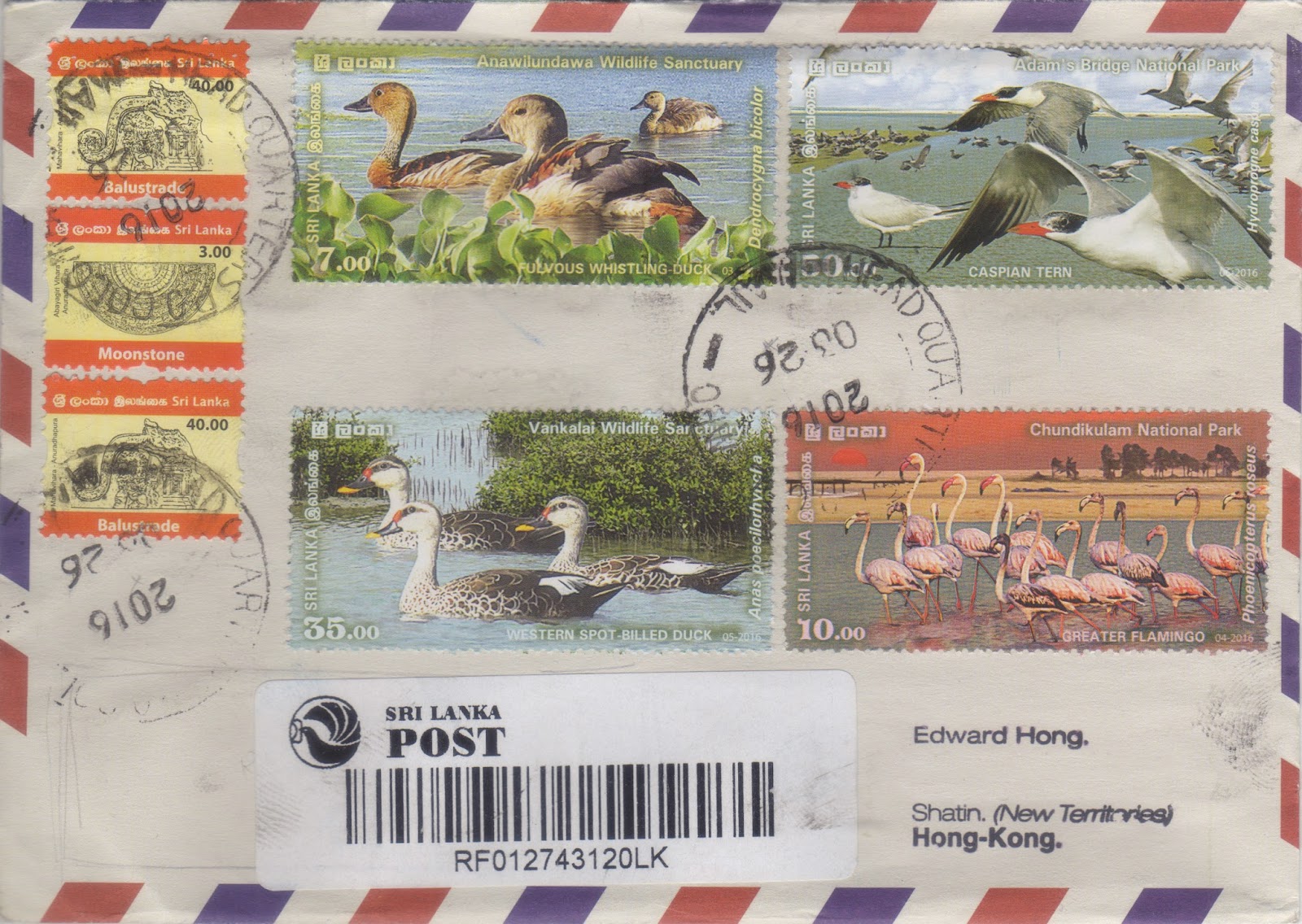
⭕️World Wetlands Day 2016

From left to right :
Rs.7 : Fulvous Whistling-duck (草黃樹鴨) ; Rs.50 : Caspian Tern (紅咀巨鷗)
Rs.35 : Indian Spot-bill Duck (印度花嘴鴨) ; Rs.10 : Greater Flamingo (大紅鶴)
Sri Lanka (2016)
26th March, 2016. Colombo

Wetlands arereferred to as habitats with permanent or temporary accumulation of water with associated floral and faunal communities. Sri Lanka has a geography which supports the formation of wetlands to a great extent. Due to diverse geographical settings, wetlands of different areas display different characteristics. There are 3 broad categories of wetlands found in the country namely:
  • Inland natural fresh water wetlands
  • Marine and saltwater wetlands
  • Man-made wetlands
The interaction between soil, water, plants and animals in the wetlands enable many functions which are useful to people as well as the entire eco-system. Sri Lanka is a mesmerizing destination for bird watching. However, the wetlands in the country beside the others are among the best places to observe Sri Lanka’s avifauna.

30 July 2016

⭕️Mandarin Duck

Mandarin Duck (鴛鴦)
China (2015)

20th February, 2016. Pengliuyang Road, Wuhan

Mandarin Duck is a perching duck species found in East Asia. It is medium-sized, at 41–49 cm (16–19 in) long with a 65–75cm wingspan. As the other member of the genus Aix, it is closely related to the North American wood duck.

The adult male is a striking and unmistakable bird. It has a red bill, large white crescent above the eye and reddish face and "whiskers". The breast is purple with two vertical white bars, and the flanks ruddy, with two orange "sails" at the back. The female is similar to female wood duck, with a white eye-ring and stripe running back from the eye, but is paler below, has a small white flank stripe, and a pale tip to its bill.

Both the males and females have crests, but the crest is more pronounced on the male.

Like many other species of ducks, the male undergoes a moult after the mating season into eclipse plumage. When in eclipse plumage, the male looks similar to the female, but can be told apart by their bright yellow-orange beak, lack of any crest, and a less-pronounced eye-stripe.

Mandarin ducklings are almost identical in appearance to wood ducklings, and very similar to mallard ducklings. The ducklings can be distinguished from mallard ducklings because the eye-stripe of mandarin ducklings (and wood ducklings) stops at the eye, while in mallard ducklings it reaches all the way to the bill.

Mandarin Duck (鴛鴦)
China (2015)

20th August, 2015. Nanping, Fujian

23 April 2016

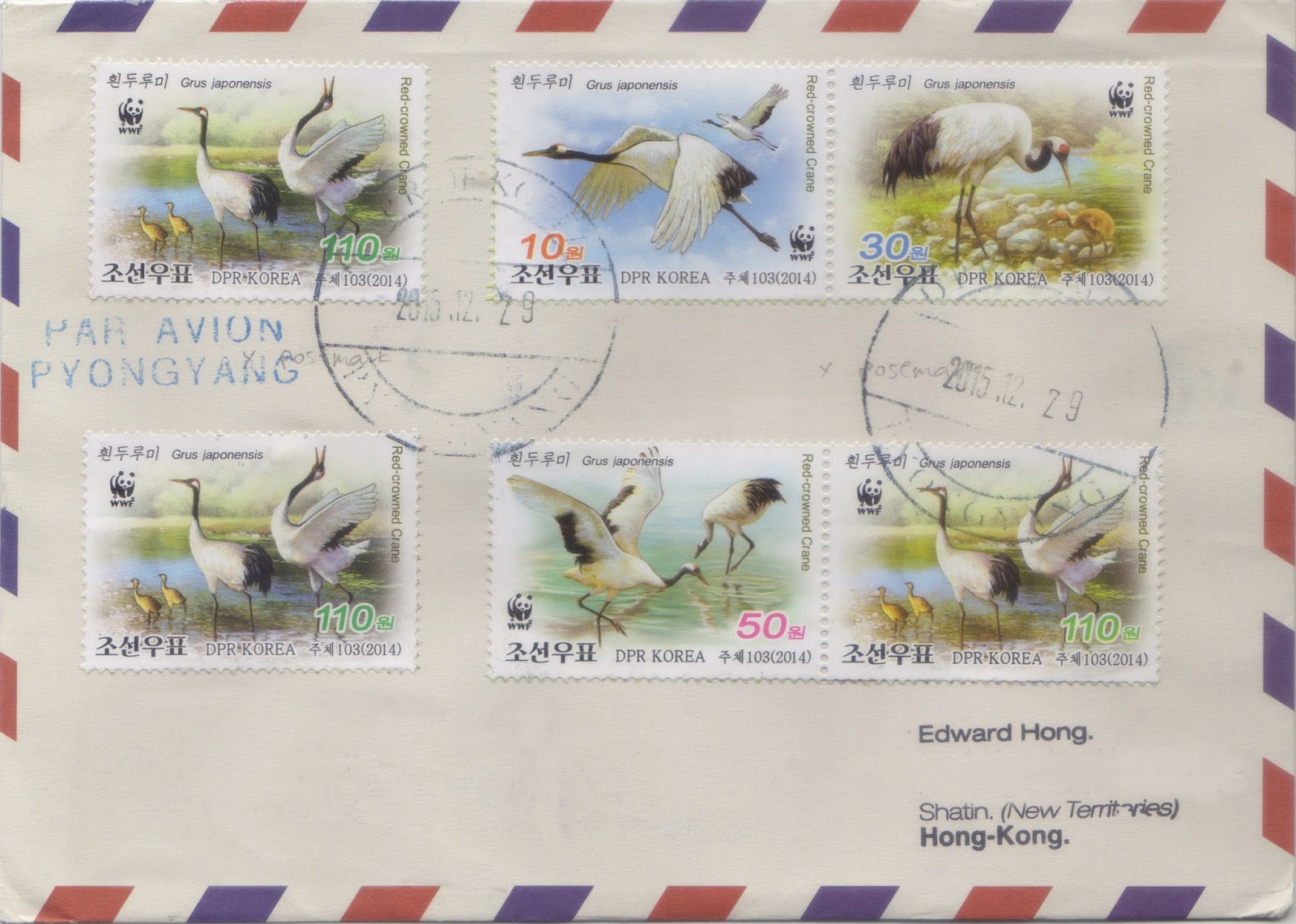
⭕️Red-crowned Crane

 
Red-crowned Crane (丹頂鶴)
North Korea (2014)

29th Deember, 2015. Pyongyang

Red-crowned Crane (丹頂鶴)
North Korea (2014)

30th May, 2016. Pyongyang
 
Red-crowned cranes are named for a patch of red bare skin on the crown, which becomes brighter in the mating season. Overall, they are snow white in color with black on the wing secondaries, which can appear almost like a black tail when the birds are standing, but the real tail feathers are actually white. Males are black on the cheeks, throat and neck, while females are pearly gray in these spots. The bill is olive green to greenish horn, the legs are slaty to grayish black, and the iris is dark brown.

This species is among the largest cranes, typically measuring about 150 to 158 cm tall and 120–150 cm in length (from bill to tail tip). Across the large wingspan, the red-crowned crane measures 220–250 cm. Typical body weight can range from 7 to 10.5 kg, with males being slightly larger and heavier than females and weight ranging higher just prior to migration. On average, it is the heaviest crane species, although both the sarus and wattled crane can grow taller and exceed this species in linear measurements. The maximum known weight of the red-crowned crane is 15 kg. Among standard measurements, the wing chord measures 56–67 cm, the exposed culmen measures 13.5–16.7 cm and the tarsus measures 25.5–30.1 cm.

19 March 2016

Conservation of the Black-necked Crane and the Critically Endangered White-bellied Heron in Bhutan

Upper : Black-necked Crane (黑頸鶴)
Lower : White-bellied Heron (
白腹鷺)
Bhutan (2015)

14th December, 2014. Thimphu

The Royal Society of Protection of Nature has been involved in the White-bellied Heron conservation project since 2003. Over the years much has been understood about their status, potential threats and conservation options in Bhutan.

As a critically endangered species in the world, it is very important to protect it and its natural habitat. The initiative has helped establish two important WBH habitat areas in Bhutan: 1) Punatsangchu basin, Wangduephodrang Dzongkhag and 2) Berti, Zhemgang Dzongkhag.

At present there are 4 individuals in Berti and 26 in Punatsangchu basin. With 30 individuals of this species in their natural habitat, Bhutan plays a pioneering role in protecting the critically endangered white-bellied heron. Although RSPN has initiated study on its ecology and breeding behavior, the rapid pace of development activities calls for immediate interventions that could provide quicker options for the survival of the bird. Captive breeding could be an immediate option to balance conservation and development by ensuring survival of the species and continuation of developmental activities - the “Middle Path” national development approach.

27 February 2016

Nias Myna

Nias Myna (尼亞鷯哥)
Indonesia (2015)
5th November, 2015. Jakarta

Nias Myna is endemic to the island of Nias in South East Asia and other nearby islands off western Sumatra.

The number of Nias Hill Mynahs has declined substantially in the wild due to trapping for the illegal pet trade and loss of habitat from deforestation. In a bird survey of Nias Island in 1990, Dymond failed to find any Nias Mynas in a 17 day stay.

They are now not available for the pet markets or importing, and are now protected.

This is a large stocky myna, averaging 30 - 36 cm or 12 - 40.5 cm or 14 inches in length. They weigh approximately 400 grams or 14 oz. It is significantly larger than the Common Hill Myna and much larger than the Greater Indian Hill. In fact, it is the largest of all the Hill mynahs.

The Nias Myna has a mainly purple-glossed black plumage. It has bright orange-yellow patches of naked skin and large fleshy yellow wattles (loose folds of skin) on the side of its head and nape. There are large white wing patches which are obvious in flight.

The massive bill is mainly red, and the strong legs are bright yellow.

30 January 2016

Golden Pheasant

Golden Pheasant (紅腹錦雞)
Taiwan (2015)

10th October, 2015. National Palace Museum

Golden Pheasant is a gamebird of the order Galliformes and the family Phasianidae. It is native to forests in mountainous areas of western China, but feral populations have been established in the United Kingdom, Canada, United States, Mexico, Colombia, Peru, Bolivia, Chile, Argentina, Uruguay, Falkland Islands, Germany, Belgium, Netherlands, France, Ireland, Australia and New Zealand. In England they may be found in East Anglia in the dense forest landscape of the Breckland as well as Tresco on the Isles of Scilly.

The adult male is 90–105 cm in length, its tail accounting for two-thirds of the total length. It is unmistakable with its golden crest and rump and bright red body. The deep orange "cape" can be spread in display, appearing as an alternating black and orange fan that covers all of the face except its bright yellow eye with a pinpoint black pupil.

Males have a golden-yellow crest with a hint of red at the tip. The face, throat, chin, and the sides of neck are rusty tan. The wattles and orbital skin are both yellow in colour, and the ruff or cape is light orange. The upper back is green and the rest of the back and rump is golden-yellow. The tertiaries are blue whereas the scapulars are dark red. Other characteristics of the male plumage are the central tail feathers, black spotted with cinnamon, as well as the tip of the tail being a cinnamon buff. The upper tail coverts are the same colour as the central tail feathers. The male also has a scarlet breast, and scarlet and light chestnut flanks and underparts. Lower legs and feet are a dull yellow.

Golden Pheasant (紅腹錦雞)
Taiwan (2015)

8th October, 2015. National Palace Museum

28 November 2015

⭕️Singapore Botanic Gardens UNESCO World Heritage Site

Singapore Botanic Gardens (新加坡植物園)
Singapore (2015)
7th August, 2015. Killiney Road

Established in 1859, the Singapore Botanic Gardens played an important historical role in the introduction and promotion of many plants of economic value to Southeast Asia, including the Para rubber tree.

Over the years, the Gardens has continued to introduce and rejuvenate its horticultural attractions while continuing its mission of connecting plants and people.

Today, the 74-hectare Gardens is a key civic and community space, and an international tourist destination. Attracting an annual visitorship of more than 4.4 million, it is also an important institution for tropical botanical and horticultural research, education and conservation.

The Gardens showcases the best and most spectacular of tropical flora, including more than 10,000 types of plants and the region’s most significant living collection of documented palms, orchids, cycads and gingers. Its historic 19th century garden landscape is well preserved and includes the earliest ornamental designed lake in Singapore. Home to numerous heritage trees and a tract of primary rainforest, the Gardens is less than a 10-minute walk from the shopping belt in Orchard Road. The Gardens was inscribed as Singapore’s first UNESCO World Heritage Site in 2015.

Up : Oriental Pied Hornbill (冠斑犀鳥)
Bottom : Lesser Whistling Duck (栗樹鴨)
Singapore (2015)
14th August, 2015. Tanglin

Singapore Botanic Gardens (新加坡植物園)
Singapore (2015)
7th August, 2015. Singapore

14 November 2015

⭕️Iraqi birds

Blue-cheeked Bee-eater (藍頰蜂虎)
Iraq (2015)
21st January, 2015. Iraq

Nature Iraq conducts scientific studies on biodiversity including birds, plants, mammals, and other taxa. In addition, through the laboratories and field staff of Blue Horizons, a private lab that Nature Iraq helped to establish, Nature Iraq has conducted sampling of water quality physical and chemical parameters and conducted sediment and bacterial analysis.

Also Nature Iraq has helped to build civil society networks to activate grassroots support for the protection of the environment, particularly the marshlands of southern Iraq and the watersheds of Kurdistan, northern Iraq. Further, Nature Iraq strives to build capacity within Iraq, both in government and in academia, to help restore and protect the environment.

European Robin (知更鳥)
Iraq (2015)
21st January, 2015. Iraq

 Common Kingfisher (普通翠鳥)
Iraq (2015)
21st January, 2015. Iraq

Tree Sparrow (麻雀)
Iraq (2015)
21st January, 2015. Iraq

European Goldfinch (紅額金翅雀)
Iraq (2015)
21st January, 2015. Iraq

7 November 2015

⭕️Wildlife in Oman

First row :
Indian Roller (棕胸佛法僧) ; Arabian Scops Owl (阿拉伯角鴞)
 Sooty Falcon (烟隼)
Second row :
Bruce's Green Pigeon (黃腹綠鳩) ; Blue-cheeked Bee-eater (藍頰蜂虎)
 Rüppell's Weaver (麗臉織布鳥) 
  Oman (2014)
26th August, 2015. Ruwi

Oman witnesses huge swarms of migratory birds during their seasonal journey between their nesting habitats and the places where they spend winters, especially those birds migrating from Europe and East Asia. Many birds, especially water fowl, migrate from faraway regions like northern Siberia, and travel about five thousand kilometres.

Visitors can see many species of birds in each of Oman’s different regions. Al Hikman Peninsula, Masirah Island, Al Wusta Governorate beaches, the Lagoons, the beaches and springs in Dhofar are ideal places for bird observation. Many of these species live in Dimaniyat Islands and in Musandam.

Indian Roller (棕胸佛法僧)
Oman (2014)
7th July, 2015. Ruwi

19 September 2015

⭕️Herons and Bitterns found in Malaysia

From left to right :
60sen : Black-crowned Night Heron (夜鷺) ; 70sen : Striated Heron (綠簑鷺)
80sen : Grey Heron (蒼鷺)
Malaysia (2015)
26th June, 2015. Seremban, Negeri Sembilan

Black-crowned Night Herons are small stocky, short-legged compared to other herons. They are handsomely attired in a tri-colour plumage of black, grey and white, with two long plumes on the nape. Night Herons are very aggressive and steal eggs and young of other heron colonies.

Black Crowned Night Herons eat a wide range of prey from aquatic invertebrates, amphibians and reptiles to land invertebrates including small mammals. Prey is shaken vigorously until stunned or killed and then juggled about in the beak and swallowed head first.

The Striated Heron also known as mangrove heron, little heron or green-backed heron, is a small heron. Striated herons are mostly non-migratory and noted for some interesting behavioral traits. Little herons are often encountered at Sungei Buloh Nature Park, hunched into a compact egg-shape on a branch over the water, motionless but intently looking out for prey. Little herons use a wide variety of hunting techniques, but usually hunt from cover and rarely forage on the open mudflats.

The grey heron is a wading bird of the heron family Ardeidae, native throughout temperate Europe and Asia and also parts of Africa. It is a large bird, standing up to 100 cm tall and measuring 84–102 cm long with a 155–195 cm wingspan. Grey Herons have long necks and powerful bills for a long and strong reach. They usually wait on the mud or at the water’s edge to snatch passing aquatic prey. They can stand motionless for hours.

 
Black-crowned Night Heron (夜鷺)
Malaysia (2015)
25th June, 2015. Kuala Selangor

12 September 2015

⭕️Traditional hunting

From top to bottom :
Golden Eagle (金雕) ; Saker Falcon (獵鷹)
Peregrine Falcon (黑翅長腳鷸)
Kyrgyzstan (2015)
15th May, 2015. Bishkek

'Salburun'which means "Hunter's Zest" in Kyrgyz language, is a traditional hunting fest that has been held annually since 1997 in the area of Issyk Kul lake in Kyrgyzstan, Central Asia.

Hunting with golden eagles is a skill handed down from generation to generation in rural Kyrgyzstan. It dates back to the times when hunting was the only means of survival in the Kyrgyz steppe. The organisers of the "Salburun" Festival revived the tradition in the form of a competition four years ago in order to preserve local culture. Hunting has always been an integral part of the nomadic lifestyle of the Kyrgyz people.

There are only a few "berkutchi" - birds of prey hunters - left in Kyrgyzstan. The majority of them learned the secrets of taming the wild bird from their fathers and grandfathers. The hunter takes the bird and begins training when it is a nesting. When it grows up, the bird remains faithful to its owner and even recognises his voice.

Kyrgyz hunters say that in former times one hunter with a golden eagle could support a large family.

Golden Eagle (金雕)
Kyrgyzstan (2015)
15th May, 2015. Bishkek

Saker Falcon (獵鷹)
Kyrgyzstan (2015)
14th May, 2015. Bishkek

Peregrine Falcon (擬游隼)
Kyrgyzstan (2015)
15th May, 2015. Bishkek

5 September 2015

⭕️Macao wetlands

Black-faced Spoonbill (黑面琵鷺)
Macao (2015)
5th May, 2015. Seac Pai Van

Wetlands, known as the “Kidneys of the Earth”, together with forests and oceans, comprise the three paramount ecosystems of the Earth. This May, to demonstrate China’s achievement in wetland conservation and its pioneering experience in the development of wetland protection, China Central Television (CCTV) kicked off a major charity programme – “Beautiful China – Tour of Wetlands” and launched an internet poll in late September. A combination of the online votes and the organising committee’s evaluation selected Macao’s wetland as one of China’s Top Ten Charming Wetlands.

Amid rapid economic development and continuing population growth, China’s wetlands face many problems such as declining biodiversity and decreased nationwide wetland area, etc. This programme aims to discover and exchange experiences on wetland conservation, and also hopes to awaken people’s awareness of conservation of the natural environment and the need to safeguard the healthy growth of wetlands. The programme started in May and included an opening ceremony, a documentary show, an internet poll and an award ceremony, etc. Across the entire network it is recorded more than 230 million people voted online, with the Macao wetland receiving more than one million votes. In combination with the evaluation by the organising committee, leaders from the State Forestry Administration, experts and scholars based on the rarity of prominent species and benefits from conservation, Macao was successfully included in the list of China’s Top Ten Charming Wetlands.

Black-faced Spoonbill (黑面琵鷺)
Macao (2015)
5th May, 2015. Seac Pai Van

Black-faced Spoonbill (黑面琵鷺)
Macao (2015)
5th May, 2015. Macao