Philatelic of Birds (English subtitle)|Regions Index
小菜鳥的博客 Philatelic of Birds (Bilingual subtitles) |文章目錄 |Content|Soapbox
Due to heavy reconstruction of this webpage, this blog is temporary suspended to renew in this summer, it will be updated again after late-autumn, thank you for your visits in these 9 years.

Showing posts with label WWF. Show all posts

6 May 2017

⭕️Antillean crested hummingbird

Antillean crested hummingbird (鳳頭蜂鳥)
British Virgin Islands (2014)

7th July, 2014. Road Town

The Antillean Crested Hummingbird is a tiny hummingbird species with a small geographic range in the Caribbean, from eastern Puerto Rico through much of the Lesser Antilles. In its range, it is easily identified both by the small size and the obvious crest. In the United States it is generally unknown, although there are a handful of disputed sightings in both Texas and Florida.

Found in a variety of habitats, typically open, lowland areas such as forest edges and clearings, parks, and residential areas. Feeds on both nectar and small insects.

Forages by taking nectar from flowers, vigorously defending favored patches from rivals. They also will take insects, both by gleaning from vegetation while hovering, or by capturing insects in flight. The nest of an Antillean Crested Hummingbird is a small cup built of plant fibers and decorated with bits of moss, lichen, and other material, built within 3 to 10 feet of the ground in a shrub, vine, or other protected area. The female usually lays 2 eggs, and she alone incubates them. She alone feeds the young once they hatch. The young fledge after about 3 weeks.

4 March 2017

⭕️Great Frigatebird

Great Frigatebird (小軍艦鳥)
Nauru (2008)

21st April, 2016. Nauru

Great Frigatebird is a large seabird in the frigatebird family. Major nesting populations are found in the Pacific (including the Galapagos Islands) and Indian Oceans, as well as a population in the South Atlantic.

It is a lightly built, large seabird up to 105cm long with predominantly black plumage. The species exhibits sexual dimorphism; the female is larger than the adult male and has a white throat and breast, and the male's scapular feathers have a purple-green sheen. In the breeding season, the male is able to distend its striking red gular sac. The species feeds on fish taken in flight from the ocean's surface (mostly flying fish), and indulges in kleptoparasitism less frequently than other frigatebirds. They feed in pelagic waters within 80km of their breeding colony or roosting areas.

7 January 2017

⭕️Levantine Shearwater

Levantine Shearwater (地中海海鸌)
Malta (1993, 2001)

6th July, 2011. Marsa

Shearwaters, which range from 35 to 65cm in length, nest in burrows on offshore islands and coastal hills in the North Atlantic, eastern South Atlantic, the Pacific and throughout the Mediterranean. These birds feed on fish, squid and other marine creatures while searing out at sea. Large flocks of Shearwaters are commonly seen between March and November, scavenging behind trawlers together with other sea birds. The Shearwater has a very particular call, similar to a crying baby.

This bird breeds in colonies on rocky islands and cliffs, using cavities and burrows. They are frequent breeders and their eggs hatch within 53 days. The largest colony in the Maltese Islands is found at Ta' Cenc cliffs while some pairs also breed on Comino as well as on the Fungus Rock at Dwejra Bay, Gozo.

1 October 2016

⭕️Red-footed Booby

Red-footed Booby (紅腳鰹鳥)
Ascension (2016)
22th February, 2016. Georgetown

Red-footed Booby is the smallest member of the booby and gannet family at about 70 cm in length and with a wingspan of up to 1m. The average weight of 490 adults from Christmas Island was 837g. It has red legs, and its bill and throat pouch are coloured pink and blue. This species has several morphs. In the white morph the plumage is mostly white (the head often tinged yellowish) and the flight feathers are black. The black-tailed white morph is similar, but with a black tail, and can easily be confused with the Nazca and masked boobies. The brown morph is overall brown. The white-tailed brown morph is similar, but has a white belly, rump, and tail. The white-headed and white-tailed brown morph has a mostly white body, tail and head, and brown wings and back. The morphs commonly breed together, but in most regions one or two morphs predominates; e.g. at the Galápagos Islands, most belong to the brown morph, though the white morph also occurs.

The sexes are similar, and juveniles are brownish with darker wings, and pale pinkish legs, while chicks are covered in dense white down.

25 June 2016

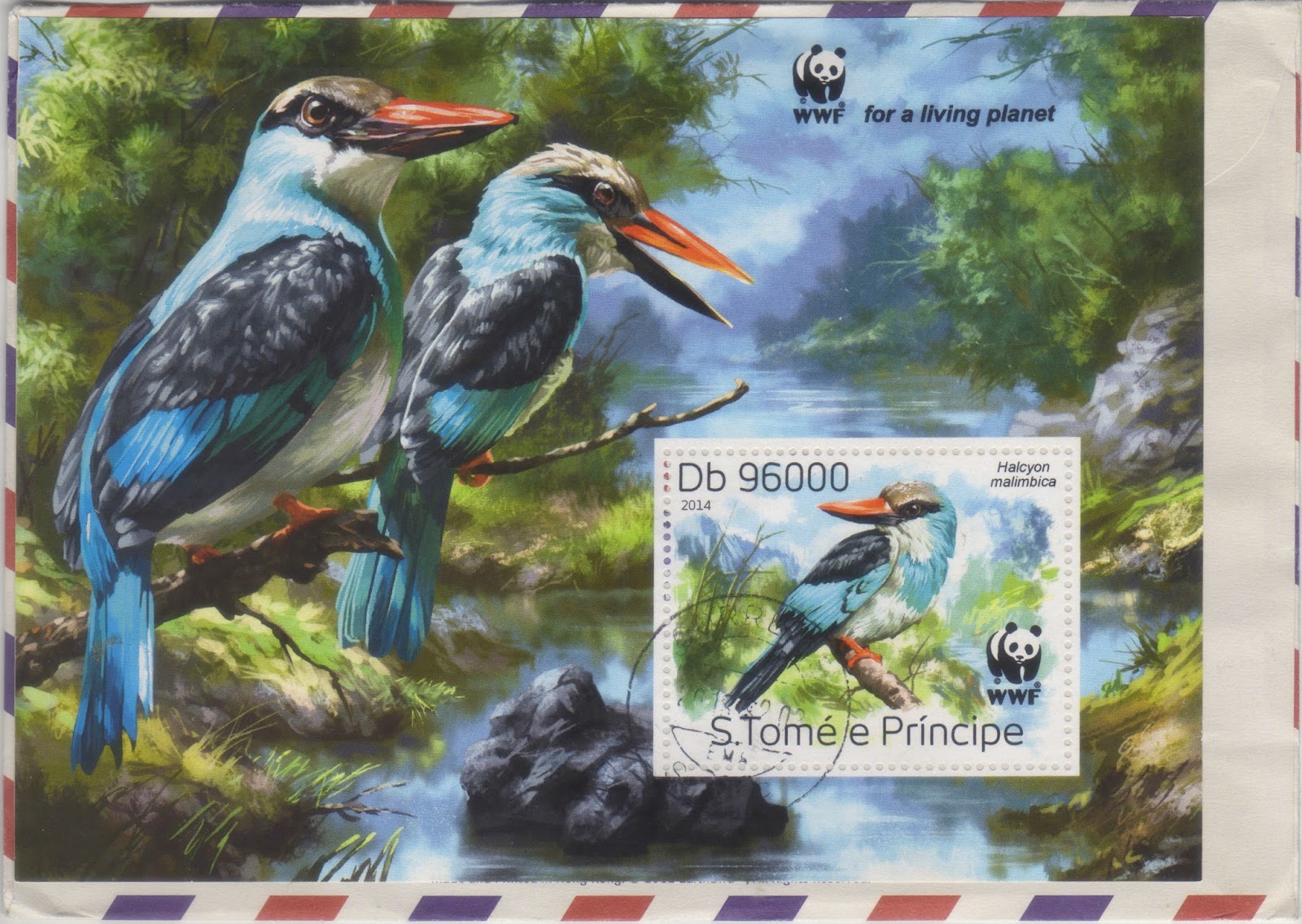
⭕️Blue-breasted Kingfisher

Blue-breasted Kingfisher (藍胸翡翠)
São Tomé e Príncipe (2015)
3rd February, 2016. São Tomé

The blue-breasted kingfisher is a tree kingfisher which is widely distributed in tropical west Africa. This kingfisher is essentially resident, but retreats from drier savanna areas to wetter habitats in the dry season.

This is a large kingfisher, 25 cm in length. The adult has a bright blue head, back, wing panel and tail. Its underparts are white, but it has a blue breast band. The shoulders are black. The flight of the blue-breasted kingfisher is rapid and direct. The large bill has a red upper mandible and black lower mandible. The legs are bright red.

The blue-breasted kingfisher is a species of a variety of well-wooded habitats. It perches quietly in deep shade whilst seeking food. It is territorial but wary. This species mainly hunts large insects, arthropods, fish and frogs, but will also eat the fruit of the Oil Palm.

It has a striking display in which the wings are spread to show the white linings. The nest is a hole in a tree termite nest. A single clutch of two round white eggs is typical.

4 June 2016

⭕️Stanley Bustard

Stanley Bustard (黑冠鴇)
Indonesia (2015)
25th January, 2016. Lome
15th February, 2016. Hongkong

Denham's bustard is the largest species in the Neotis genus, although is smaller than the bustards in the Ardeotis genus (as well as the great bustard). The male is 9 to 10 kg and 100–116 cm, the female is much smaller at 3 to 4 kg and 80–87 cm. The back is brown, darker and plainer in the male, and the underparts are white. The neck is pale grey with an orange nape. Its grey crown is bordered with black, and a black line runs through the eye with a white line forming an eyebrow above. The long legs are pale yellow. The wings are strikingly patterned in brown, white and black, the male showing more white in flight than the female or young birds. The long legs are yellowish in color and the bill is whitish horn in colour.

The male inflates his throat when displaying to show a conspicuous balloon of white feathers. This species is usually silent.

23 April 2016

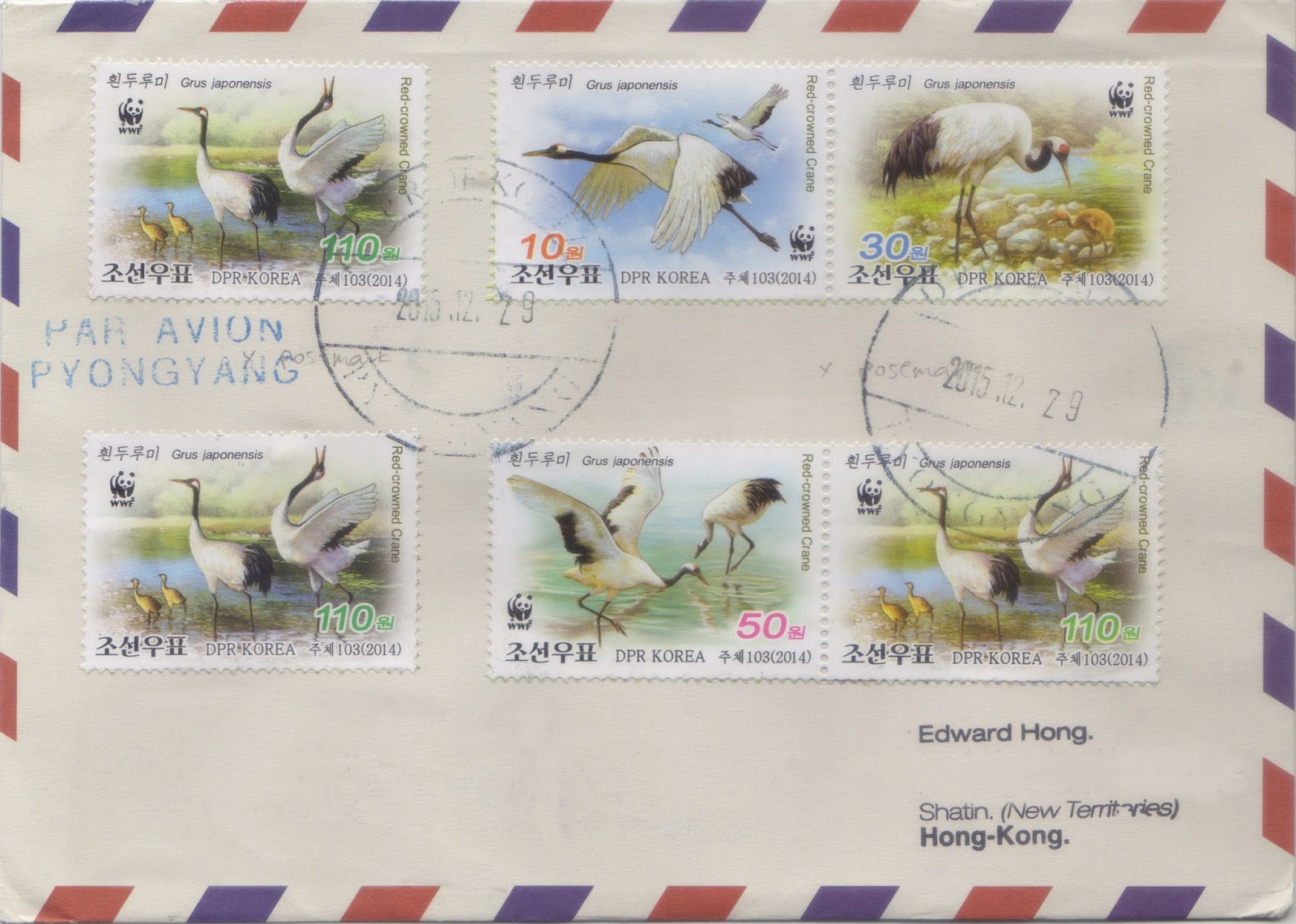
⭕️Red-crowned Crane

 
Red-crowned Crane (丹頂鶴)
North Korea (2014)

29th Deember, 2015. Pyongyang

Red-crowned Crane (丹頂鶴)
North Korea (2014)

30th May, 2016. Pyongyang
 
Red-crowned cranes are named for a patch of red bare skin on the crown, which becomes brighter in the mating season. Overall, they are snow white in color with black on the wing secondaries, which can appear almost like a black tail when the birds are standing, but the real tail feathers are actually white. Males are black on the cheeks, throat and neck, while females are pearly gray in these spots. The bill is olive green to greenish horn, the legs are slaty to grayish black, and the iris is dark brown.

This species is among the largest cranes, typically measuring about 150 to 158 cm tall and 120–150 cm in length (from bill to tail tip). Across the large wingspan, the red-crowned crane measures 220–250 cm. Typical body weight can range from 7 to 10.5 kg, with males being slightly larger and heavier than females and weight ranging higher just prior to migration. On average, it is the heaviest crane species, although both the sarus and wattled crane can grow taller and exceed this species in linear measurements. The maximum known weight of the red-crowned crane is 15 kg. Among standard measurements, the wing chord measures 56–67 cm, the exposed culmen measures 13.5–16.7 cm and the tarsus measures 25.5–30.1 cm.

9 April 2016

Yellow-billed Stork

Yellow-billed Stork (黃嘴䴉鸛)
Gambia (2011)

9th December, 2015. Tranqueras

Yellow-billed stork, sometimes also called the wood stork or wood ibis, is a large African wading stork species in the Ciconiidae family. It is widespread in regions south of the Sahara and also occurs in Madagascar.

The yellow-billed stork is closely related to 3 other species in the Mycteria genus: the American woodstork (Mycteria americana), the milky stork (Mycteria cinerea) and the painted stork (Mycteria leucocephala). It is classified as belonging to one clade with these 3 other species because they all display remarkable homologies in behavior and morphology. In one analytical study of feeding and courtship behaviours of the wood-stork family, MP Kahl attributed the same general ethology to all members of the Mycteria genus, with few species-specific variations. These four species are collectively referred to as the wood-storks, which should not be confused with one alternative common name (wood-stork) for the yellow-billed stork.

Before it was established that the yellow-billed stork was closely related to the American woodstork, the former was classified as belonging to the genus Ibis, together with the milky stork and painted stork. However, the yellow-billed stork has actually long been recognised as a true stork and along with the other 3 related stork species, it should not strictly be called an ibis.

11 October 2014

⭕️Blue Lorikeet

Blue Lorikeet (塔布吸蜜鸚鵡)
Aitutaki (2002)
16th July, 2014. Aitutaki

Blue lorikeet is a small lorikeet from French Polynesia and the Cook Islands. It is also known as the Tahiti lorikeet, violet lorikeet, Tahitian lory, blue lory, nunbird, and the indigo lory. It was formerly found on 23 islands around Tahiti, but now restricted to perhaps eight islands: Motu, Manuae, Tikehau, Rangiroa, Aratua, Kaukura, Apataki, Aitutaki, and possibly Harvey Island and Manihi. Its plumage is mainly dark blue and it has a white area over its upper chest, throat and face. The first captive breeding in the UK was by the Marquess of Tavistock in the 1930s. He was awarded a silver medal by the Foreign Bird League for this achievement.

24 May 2014

Short-toed Eagle

Short-toed Eagle (短趾雕)
Azerbaijan (2011)
3rd April, 2014. Baku

This is an Old World species spread throughout the Mediterranean basin and into Russia and the Middle East, and into parts of Asia, mainly in the Indian Subcontinent and also further east in some Indonesian islands.

Those present on the northern edge of the Mediterranean and other parts of Europe migrate mainly to sub-Saharan Africa north of the equator, leaving in September/ October and returning in April/ May. In the Middle and Far East the populations are resident. In Europe it is most numerous in Spain where it is fairly common but elsewhere it is rare in many parts of its range. A bird on the Isles of Scilly, Britain, in October 1999 was the first confirmed record for that country.

The Short-toed Snake Eagle is found in open cultivated plains, arid stony deciduous scrub areas and foothills and semi-desert areas. It requires trees for nesting.

9 December 2013

⭕️Tristan Albatross

Tristan Albatross (特島信天翁)
Tristan da Cunha (2013)
12th August, 2013. Tristan da Cunha

Tristan Albatross (Diomedea dabbenena) is a large seabird from the albatross family, which was only widely recognised as a full species in 1998. Due to the difficulty in distinguishing them from Wandering Albatrosses, their distribution at sea is still not fully known, but the use of satellite tracking has shown that they forage widely in the South Atlantic, with males foraging west of the breeding islands towards South America and females to the east towards Africa. There have been sightings near Brazil and also off the coast of Australia.

The Tristan Albatrosses are endemic to the islands of the Tristan da Cunha group and more specifically Gough Island. The majority of the world's population nest on Gough Island, around 1500 pairs. On some years a pair breeds on Inaccessible Island.

30 September 2013

⭕️Ducorps' Cockatoo

Ducorps' Cockatoo (杜氏鳳頭鸚鵡)
Solomon Islands (2013)
21st June, 2011. Honiara

The Ducorps' Cockatoo, also known as Solomons Corella or Broad-crested Corella, is a species of cockatoo endemic to the Solomon Islands. This small white cockatoo is larger than the Tanimbar Corella yet smaller than the Umbrella Cockatoo. The species is common across most of the Solomons, absent only from Makira in the south. It inhabits lowland rainforests, secondary forests, cleared areas and gardens. The Solomons Cockatoo nests in tree cavities. The eggs are white and there are usually two in a clutch. The eggs are incubated for about 25 days and the chicks leave the nest about 62 days after hatching.

The northern common cuscus, also known as the grey cuscus, is a species of marsupial in the Phalangeridae family native to northern New Guinea and adjacent smaller islands, but is now also found in the Bismarck Archipelago, south-east and central Moluccas, the Solomons and Timor, where it is believed to have been introduced in prehistoric times.

Two species are not endanger species but appear on the stamps.

Northern Common Cuscus (灰袋貂)
Solomon Islands (2002)

15 September 2013

Black Crowned-crane

Black Crowned-crane (黑冠鶴)
The Gambia (2006)

7th July, 2013. Banjul

Black Crowned-crane is a bird in the crane family Gruidae. It occurs in dry savannah in Africa south of the Sahara, although in nests in somewhat wetter habitats. This species and the closely related Grey Crowned-crane (東非冕鶴), which prefers wetter habitats for foraging, are the only cranes that can nest in trees. Like all cranes, Black Crowned-crane eats insects, reptiles, and small mammals. It is endangered, especially in the west, by habitat loss and degradation.

Black Crowned-crane (黑冠鶴)
The Gambia (2006)

27th February, 2006. Banjul

3 August 2013

Papyrus Gonolek

Papyrus Gonolek (穆富氏黑伯勞)
Burundi (2011)
11th June, 2013. Bujumbura

Papyrus Gonolek is a species of bird in the Malaconotidae family. It is found in Burundi, Democratic Republic of the Congo, Kenya, Rwanda, Tanzania, and Uganda. It has specialised habitat requirements, being restricted to papyrus swamps. Not yet a threatened species, it has become rare due to habitat loss and pollution.

The cover is the last of WWF 50th anniversary series, total are 11 covers collected.

19 July 2013

Secretarybird

Secretarybird (蛇鷲)
Uganda (2012)
30th April, 2013. Kampala
3rd May, 2013. Sorting Centre, Kampala

The last cover features Secretarybird was come from Eritrea, however it doesn't look good as the cover features 3 species. Here is the new one, it is more beautiful and attractive, the latest WWF issue of Uganda. As before, 4 stamps illustrated different activity of Secretarybird. Although the stamps coordinated by Stamperija, it still collectable to all bird theme stamp collector.

Please specially take a look of the airmail label, it features the logo of Uganda Airlines, but it closed for 20 years. The logo of the airline is Grey Crowned-Crane (灰冠鶴), which is a national bird of Uganda.

29 June 2013

Iran's owls

From left to bottom :
1100Rls. : Spotted Owlet (斑腹小鴞) ; 600Rls. : Northern Long-eared Owl (長耳鴞)
1600Rls. : Pallid Scops-Owl (縱紋角鴞) ; 2200Rls. : Brown Fish-Owl (褐漁鴞)

Iran (2011)
14th December, 2011. Tehran (Philatelic Bureau)

This stamp set also celebrated 50th anniversary of WWF but it stored in my album for a long time, few months ago I decided to obtain cancellation and finally get a nice FDI postmark. Four species are selected as endemic species to middle-asia area.

The big problem is, who knows what the red-postmark read?

19 May 2013

Loons and grebes

From left to right :
Red-throated Loon (紅喉潛鳥) ; Horned Grebe (角鸊鷈)
Great Crested Grebe (鳳頭鸊鷉) ; Black-throated Loon (黑喉潛鳥)

Åland (2013)
5th April, 2013. Mariehamn

After many years, Åland issued new WWF stamps again, this time feature 4 loons and grebes commonly to be found in this small islands. I decided order a FDC from the philatelic bureau, but sadly the shame Hongkong Post once again damaged this beautiful (and quite expensive) FDC.

21 January 2013

⭕️WWF stamps again of South Georgia

From left to right :
70p : Antarctic Tern (南極燕鷗) ; 60p : South Georgia Shag (南喬治亞鸕鶿)
95p : Brown Skua (褐賊鷗) ; £1,10 : Kelp Gull (黑背鷗)

South Georgia and South Sandwich Islands (2012)
20th August, 2012. King Edward Point

In each few years, the South Georgia and South Sandwich Islands issues their WWF stamps, the above cover features the latest WWF stamp set issued on 2012, this is the first time features 4 species instead as before - 1 species for 4 stamps.

For species are common in sub-Antarctic ocean and islands - Antarctic Tern looks similar with Arctic Tern (北極燕鷗), however the wings of Antarctic Tern are in grey colour and only actives in Antarctic Ocean. South Georgia Shag is endemic to South Georgia and some sub-Antarctic Islands of South Atlantic Ocean. Brown Skua is a large seabird that breeds in the sub-Antarctic and Antarctic zones and moves further north when not breeding. Kelp Gull to be found in wide area of sub-Antarctic, southern Africa, South-America and Australia, include those offshore islands.

Below is the receipt of the registered mail, it shown that the post office still using traditional registration label in 2012.

13 October 2012

⭕️Collared Lory

Collared Lory (綠領吸蜜鸚鵡)
Fiji (2012)

11th July, 2012. Suva
20th July, 2012. Suva registration office

Actually I dislike nowadays WWF issues, as most of stamps set in high denomination. For example Liechtenstein on last year, whole set of the stamps are selling in 8 Swiss Franc, although they are beautiful and attractive. It seems discourage collector to buy more for their collection. In recent years, most of WWF stamps are sell in a sheetlet which contains 2 or 4 sets of stamps. That causes people will spend more in each issue and easily to be as fast as give up this hobby. This time, as well as last time, Fiji issued a attractive sheet includes 2 sets total value near 7 Euro. I still ordered a FDC and 2 sheets, the only reason is it related to parrot.

Collared Lory is an endemic species to Fiji, specially it can be found from forest to urban area, like Lau Island and Lakeba. The live of the parrot has been humanized to suitable urban situation, especially Suva, the capital of Fiji.

Collared Lory is not an endangered species, due to seem the organization agreed to approve more non-dangered species appear onthe stamps.

18 July 2012

Jackass Penguin

Jackass Penguin (非洲企鵝)
Namibia (1997)

18th April, 2012. Windhoek

Jackass Penguin is the only one penguin species to be found in Africa continent. Most of them inhabiting in Namibia and South Africa, one of attractive popular birdwatching place is Boulders Beach which is open to public.

The other name of the penguin called Black-footed Penguin, as their legs in black colour. They also have black strip and spots on the chest, the patten is unique to each penguin like fingerprints of human. In 1910, the penguin with 1,5million population while only leave 10% of them in recent years. The reasons are the eggs be stolen and the damage of inhabit places.

Now the penguin listed as Endangered class in IUCN list. This stamp set of Jackass Penguin is one of earliest issue of this species.