Philatelic of Birds (English subtitle)|Regions Index
小菜鳥的博客 Philatelic of Birds (Bilingual subtitles) |文章目錄ContentSoapbox
Due to heavy reconstruction of this webpage, this blog is temporary suspended to renew in this summer, it will be updated again after late-autumn, thank you for your visits in these 9 years.

Showing posts with label Europe. Show all posts

10 June 2017

Luxembourg

Little Owl (縱紋腹小鴞)
Luxembourg (2008)

27 May 2017

Treasures from German Museums

Demoiselle Crane (蓑羽鶴) ; Red-billed Toucan (紅嘴巨嘴鳥) and
Black Crowned-Crane (黑冕鶴)
Germany (2017)

2nd January, 2017. Bonn

The French court painter Jean-Baptiste Oudry (1686-1755) set the vain beauty contest of three feathered opponents in his painting "Pfefferfresser, Jungfern- und Haubenkranich" (1745). The master of the exotic animal portrait does not only understand the virtuoso play with color and light. Experts also attest to a subtle and nuanced approach to his "models", which gives these almost human traits. On the threshold of Rococo at the time of the Enlightenment animals were also given a soul in animals.

Oudry, one of the most important painters of his time and a respected figure in the cultural life of Paris, studied the behavior of animals in nature. As court painter of Louis XV. He specialized in dramatic jazz scenes, which belonged to the king's favorite subjects. Famous is his zoologically accurate depiction of the exotic animals in the royal menagerie - especially the life-size picture of the Indian rhino lady "Clara". For about 25 years Oudry worked for the French court and made a name for himself all over Europe. Until his death, he created around 1000 paintings and 3000 drawings.

The impressive painting by Clara was shown in the Paris Salon in 1749, and in 1750 by Duke Christian Ludwig II of Mecklenburg-Schwerin, together with a series of menagerie paintings. Around 56 drawings by the celebrated court painter went into the possession of the Schweriner Hof, so that today a closed collection of Oudry's works is still located in Mecklenburg-Vorpommern. With 34 paintings - among them "pepper-eaters, gannets and caterpillars" - and about forty manuscripts, Schwerin owns the worlds largest collection of the French animal painter. The menagerie paintings were moved from Staatliche Museum Schwerin to the baroque palace Ludwigslust in 2016, 35 kilometers south of the state capital.

20 May 2017

⭕️Aerogramme of Giibraltar

From left to right :
Mediterranean Shag (地中海鸕鶿) ; Eurasian Hoopoe (戴勝)
Gibraltar (1992, 2008)

25th August, 2016. Gibraltar

Gibraltar has long been known as a key location for observing birds so we thought what better subject for the 2008 Definitive. The ‘Birds of the Rock’ Definitive focuses on some of the beautiful birds that grace Gibraltar’s skies.

Hoopoe breeds throughout the Mediterranean and is known to many locals as ‘Gallito de Marzo’. They are particularly noticeable around the Alameda Gardens in March during its main migration period every spring.

Mediterranean Shag is a small breeding colony of 5-8 pairs of this threatened seabird breeds in sea caves along the east side of Rock. The Gibraltar colony is possibly the only one left on mainland Iberia.

15 April 2017

Varity events in Germany

Bird of the year 2016 :
Goldfinch (紅額金翅雀)
Germany (2016)

11th September, 2011. Neckarwestheim

50th anniversary of BSV :
Goldfinch (紅額金翅雀)
Germany (2016)

6th November, 2011. Gaildof

150th anniversary of Post in Haiteebach :
Common Cuckoo (普通杜鵑)
Germany (2017)

15th January, 2017. Haiteebach

8 April 2017

⭕️Bird definitive series (3) of Slovenia

€0,25 : European Green Woodpecker (綠啄木鳥) ; €0,30 : European Honey Buzzard (鵰頭鷹)
€0,50 ; Hazel Grouse (花尾榛雞), €0,75 : Firecrest (火冠戴菊)
€1,00 : European Bee-eater (黃喉蜂虎)
Slovenia (2016)

27th May, 2016. Maribor

European Green Woodpecker is one of the largest members of the woodpecker family, growing to a length of 30–33 cm. Its habitat consists of open areas with some trees, preferably old orchards. The female lays clutches of five to seven eggs in unlined tree cavities. It feeds on insects, especially ants, and therefore spends a lot of time on the ground hunting food with the help of its remarkably long tongue. It is a widely distributed species in Slovenia and a common species throughout the year.

European Honey Buzzard lives in open deciduous and mixed woodland bordering pastures and meadows. It usually builds its nest high in a tree and will frequently occupy the abandoned nest of other birds. The female lays one clutch of one to three eggs. It feeds on wasp larvae, adult wasps and bees, and also on amphibians and birds. The European honey buzzard is a summer species that migrates via Gibraltar, Sicily and the Bosporus to southern Africa. It is a relatively common nesting species in Slovenia.

Hazel Grouse is one of the smaller members of the grouse family, growing to a length of 35–37cm. It lives in coniferous and mixed forests with some undergrowth and, unlike the other members of the family, remains within a very small area, of just a few hundred square metres, throughout the year. It lives in pairs and is very shy, and therefore difficult to observe. The female lays clutches of six to ten eggs and both parents care for the chicks. The hazel grouse feeds on a variety of plant food (buds, shoots and seeds). It is relatively widely distributed in Slovenia and is found in all mountainous areas.

Common Firecrest is one of two members of the kinglet family found in Slovenia, it grows to a length of 8.5–9cm and weighs barely more than 5.5 g. Its habitat consists of coniferous and mixed forest, where it tirelessly hunts tiny insects among the needles and leaves of trees. It builds a bowl-shaped nest high up in a tree, where the female lays between seven and eleven eggs. Each female lays two clutches. A relatively common summer species in Slovenia, individual specimens also remain over the winter in southern areas.

European Bee-eater iswonderfully coloured member of the bee-eater family grows to a length of 27–29 cm. Its preferred habitat is open areas with clayey or sandy cliffs in which to dig a breeding burrow. The European bee-eater nests in colonies. The female lays clutches of four to seven eggs and both parents incubate and care for the chicks. Bee-eaters are aerial hunters of prey consisting of the larger insects, such as dragonflies, and also bees. This summer species migrates south in autumn. It is a very rare nesting species in Slovenia.

25 March 2017

⭕️Birds of Georgia

1,0L : Little Bustard (小鴇) ; 0,6L : Caucasian Black Grouse (高加索黑琴雞)
0,4L : Grey Partridge (灰山鶉)
Gambia (2011)

29th July, 2016. Akhaltsikhe

Georgia is located at the edge of Asia and Europe. Georgia is a country of exceptional beauty: diverse in nature, with rich and ancient history. The country is mostly complex and mountainous. The highest peak is 5201m (peak Shkhara) above sea level. Due to Georgia's specific geographic location, on a relatively small territory (69,700 square km.) there are extremely diverse ecosystems from Alpine meadows to semi-deserts, wetlands, costal landscape, numerous lakes and rivers, caves, magnificent mountain-chains and peaks covered with eternal snow.

In Georgia there are several spectacular birdwatching locations, with very different characteristics. Each of them is interesting in terms of species composition. On a relatively small territory there is a multitude of diverse ecosystems. This is very favorable for bird watching, as in a short period of time and in area very close to each other it is possible to see birds from totally different habitats.

Birders tend to target the 'big five' species: Caucasian Snowcock, Caucasian Black Grouse, Great Rosefinch, Güldenstädt’s Redstart and Caucasian Chiffchaff but other regional specialties including: Twite (interior Asian form - a potential split), Red-fronted Serin, Wallcreeper, Citrine Wagtail, White-winged Snowfinch, Red-billed and Alpine Choughs, Chukar, Horned Lark, Water Pipit, Greenish Warbler, Barred Warbler, Alpine Accentor, Common Rosefinch and dozens of other species.

18 March 2017

⭕️The New Zwin

Common Shelduck (翹鼻麻鴨) ; Common Tern (普通燕鷗) ; Barn Swallow (家燕)
Pied Avocet (反嘴鷸) ; Eurasian Spoonbill (白琵鷺)
Belgium (2016)
16th June, 2016. Roesela

The new Zwin is the international migratory bird airport. It is a unique and varied top attraction where you experience nature to the full. The new Zwin has something in store for everyone.

The Zwin Nature Park is an interactive nature experience park for the entire family. It is a place where you can discover the special Zwin nature in an attractive and stimulating manner.

Apart from the Zwin Nature Park, the Zwin is accessible free of charge: the Zwin Bistro, the Zwin Shop, the Zwin Region Information Centre and no less than 220ha of Zwin dunes and polders which guide you to the Zwin Nature Park on foot or by bike from Knokke Het Zoute.

4 February 2017

Wildes Deutschland

Postmark : Golden Eagle (金鵰)
Germany (2016)

26th June, 2016. Zürpich

Postmark : Nightingale (夜鶯)
Germany (2016)

23rd June, 2016. Berlin

Phytogeographically, Germany is shared between the Atlantic European and Central European provinces of the Circumboreal Region within the Boreal Kingdom. The territory of Germany can be subdivided into two ecoregions: European-Mediterranean montane mixed forests and Northeast-Atlantic shelf marine.[37] The majority of Germany is covered by either arable land (33%) or forestry and woodland (31%). Only 15% is covered by permanent pastures. Plants and animals are those generally common to middle Europe. Beeches, oaks, and other deciduous trees constitute one-third of the forests; conifers are increasing as a result of reforestation. Spruce and fir trees predominate in the upper mountains, while pine and larch are found in sandy soil. There are many species of ferns, flowers, fungi, and mosses. Fish abound in the rivers and the North Sea. Wild animals include deer, wild boar, mouflon, fox, badger, hare, and small numbers of beaver. Various migratory birds cross Germany in the spring and autumn.

7 January 2017

⭕️Levantine Shearwater

Levantine Shearwater (地中海海鸌)
Malta (1993, 2001)

6th July, 2011. Marsa

Shearwaters, which range from 35 to 65cm in length, nest in burrows on offshore islands and coastal hills in the North Atlantic, eastern South Atlantic, the Pacific and throughout the Mediterranean. These birds feed on fish, squid and other marine creatures while searing out at sea. Large flocks of Shearwaters are commonly seen between March and November, scavenging behind trawlers together with other sea birds. The Shearwater has a very particular call, similar to a crying baby.

This bird breeds in colonies on rocky islands and cliffs, using cavities and burrows. They are frequent breeders and their eggs hatch within 53 days. The largest colony in the Maltese Islands is found at Ta' Cenc cliffs while some pairs also breed on Comino as well as on the Fungus Rock at Dwejra Bay, Gozo.

24 December 2016

⭕️Lake Constance

Mute Swan (疣鼻天鵝)
Switzerland (2016)

12st May, 2016. Romanshorn

Black-headed Gull (紅嘴鷗)
Switzerland (2016)

12th May, 2015. Ermatingen

Let’s get one thing clear from the start: anyone hoping to spot a monster is going to be disappointed. Surrounded by three countries, the waters do not conceal any sea creatures in the vein of Nessie, for ex- ample. With its wealth of islands, Lake Constance is simply too idyllic for that. However, anglers near Bregenz did recently catch a huge wels catfish measuring 2.5 metres in length. Experts even suspect the existence of older and larger specimens gliding through the depths, measuring up to 3 metres in length and weighing well over 100 kilograms. But this shouldn’t stop anyone from enjoying their water-sports or indulging their fas- cination with the stunning sunsets and fantastic cloud formations reflected in the enormous mirrored surface. This natural wonder consists of three bodies of water: the Obersee (upper lake), Untersee (lower lake) and Seerhein, which links the first two. The shoreline of this gem is shared by three countries. So it is no surprise that Swiss Post has chosen to pres- ent its new special stamp as a triptych.

17 December 2016

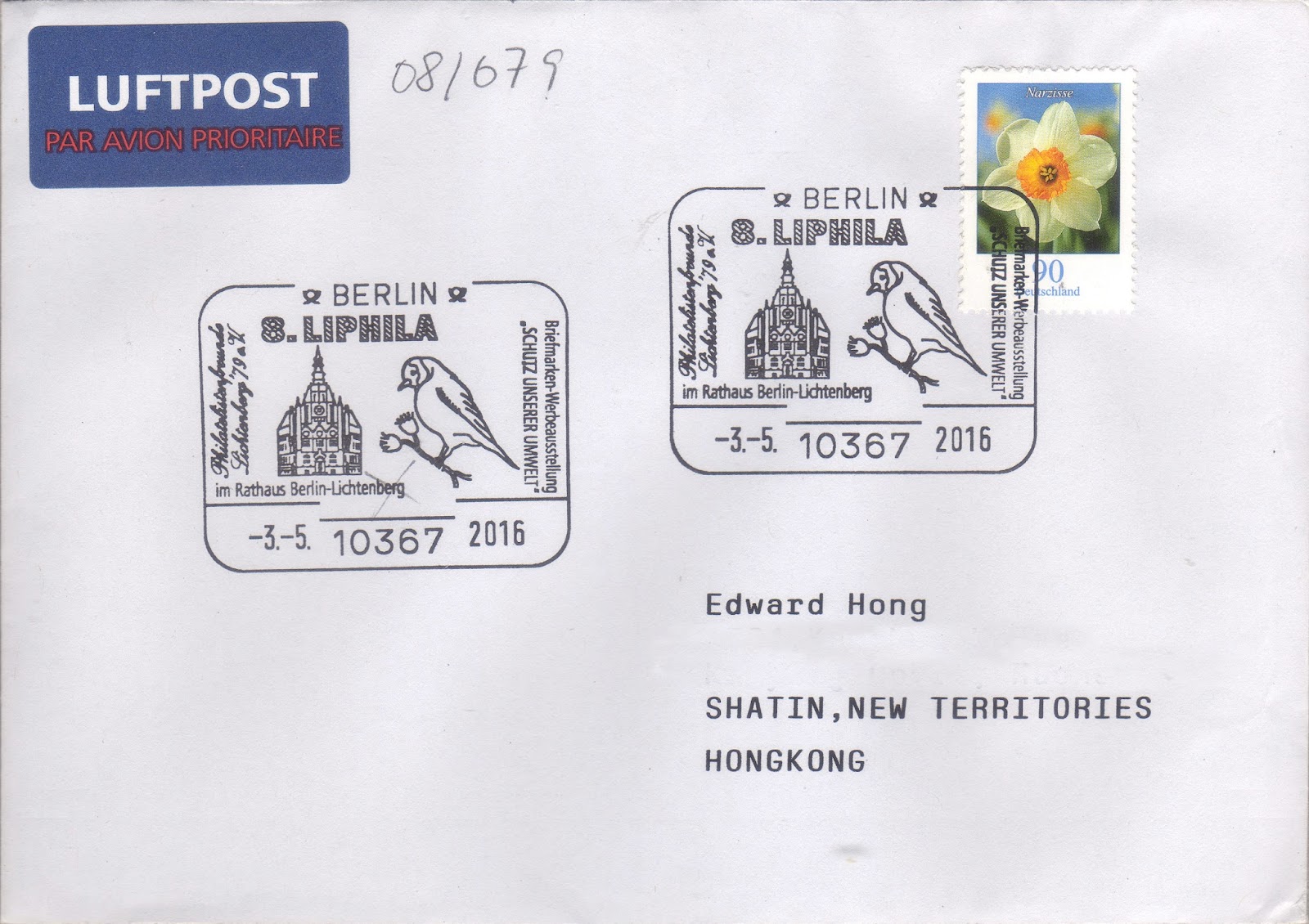
Goldfinch

Goldfinch (紅額金翅雀)
Germany (2016)
3rd May, 2016. Berlin

Lichtenberg is the eleventh borough of Berlin, Germany. In Berlin's 2001 administrative reform it absorbed the former borough of Hohenschönhausen.

The district contains the Tierpark Berlin in Friedrichsfelde, the larger of Berlin's two zoological gardens. Lichtenberg was also the site of the extensive headquarters complex of the Stasi, the East German intelligence service. Prior to the establishment of the GDR it housed the main office of the Soviet Military Administration in Berlin, and before that it was an officers' mess of the Wehrmacht. The complex is now the location of the Stasi Museum. The Berlin-Hohenschönhausen Memorial is on the site of the main remand prison of the Stasi. Lichtenberg is also the location of the German-Russian Museum, the historical venue of the unconditional surrender of the German armed forces (Wehrmacht) on 8 May 1945.

3 December 2016

⭕️Nocturnal animals

Tawny Owl (灰林鴞)
Switzerland (2016)
12th May, 2016. Wildegg


Tawny Owl (灰林鴞)
Switzerland (2016)
12th May, 2016. Bern 

At night, when all good citizens make their way to bed to sleep the sleep of the just, it’s time for some creatures to really start their revels and turn our night into their day. Under cover of darkness, they go in search of their prey – silently creeping, flying and lurking – and feast on their bounty or attract potential mates to play by the light of the silvery moon. Mother Nature has equipped them well over thecourse of evolution: with an acute sense of hearing, highly sensitive sight, organs of touch, radar-like systems, their own light sources and many other aids. Swiss Post is now devoting a set of special stamps to four native nocturnal animals: the tawny owl, the garden dormouse, the European glow-worm and the hedgehog. The stamps can, of course, be used night and day.

26 November 2016

Saxon Switzerland

White-throated Dipper (河烏)
 Germany (2016)
2nd June, 2016. Berlin

Saxon Switzerland is a hilly climbing area and national park around the Elbe valley south-east of Dresden in Saxony, Germany. Together with the Bohemian Switzerland in the Czech Republic it forms the Elbe Sandstone Mountains.

Saxon Switzerland alone has some 1,000 climbing peaks, as well as several hollows. The area is popular with Dresden locals and international climbers.

The administrative district for the area is Sächsische Schweiz-Osterzgebirge. The fortress of Königstein is a well-known landmark.

22 October 2016

⭕️Birds of Greenland

5kr. : Rock Ptarmigan (岩雷鳥) ; 10kr. : Snowy Owl (雪鴞) ; 3kr. Gyrfalcon (矛隼)
4,10kr. : Raven (渡鴉) ; 5,50kr. : White-tailed Eagle (白尾鷲)
7kr. : Great Northern Diver (普通潛鳥) ; 3,20kr. : Long-tailed Duck (長尾鴨)
4,40kr. Snow Bunting (雪鵐) ; 5,50kr. : Black Guillemot (黑海鳩)
6,50kr. : Brunnich's Guillemot (厚嘴海鴉) ; 4kr. : Snow Goose (雪雁)
7,50kr. Long-tailed Jaeger (長尾賊鷗)
Greenland (1987, 1988, 1989, 1990)

14th April, 2016. Aasiaat, Iginniarfik

There are 235 different species of bird in the airspace over Greenland. Some of these birds also breed on land, they include the majestic sea eagle.

The majority of Greenland's birds are migratory birds and there are therefore only around 60 species that are regarded as permanent breeders in the country.

In addition to the birds above, a number of other birds should also be mentioned. This applies in particular to the black raven, which is probably the bird that the majority of people notice. The raven is in the crow family and breeds all over the country.

Its characteristic croaking call can be heard very clearly if you are out hiking.

The snow bunting is another very common bird that leaves Greenland in about September and returns in March. Greenland also has two species of falcon - the peregrine falcon and the gerfalcon - which are both protected species.

15 October 2016

⭕️Songbirds of Romania

From left to right :
9,10L : Bullfinch (紅腹灰雀) ; 8,10L : Bohemian Waxwing (太平鳥)
5L : Yellowhammer (黃鵐) ; 4,50L : Hawfinch (錫嘴雀)
Romania (2015)

25th April, 2016. Noluntari

Romfilatelia proposes to bird lovers and philatelists a special postage stamp issue illustrating Songbirds. Also called Oscines (from the Latin word oscine meaning songbird), these were assigned by ornithologists to the order Passeriformes, being characterized by the diversity of size and plumage.

8 October 2016

⭕️Protected wildlife in Romanian reserves

 
8,10L, 5L : Eastern White Pelican (白鵜鶘)
3,60L, 9,10L : Dalmatian Pelican (卷羽鵜鶘)
Romania (2015)
25th April, 2016. Voluntari

In each year, Romfilatelia recalls the richness of the natural heritage of Romania by introducing into circulation a postage stamp issue dedicated to the species of pelicans living in their country, as part of a broader topic consecrated to protected wildlife from Romanian reserves. In 2015, The Danube Delta Biosphere Reserve celebrates its 25th anniversary this year, it developed on 1990 and as known as Delta Dunării in Romanian is the only delta in the world entirely declared a biosphere reserve and a UNESCO World Heritage Site since 1991, it shelters an impressive number of pelicans from both species, these birds being declared a natural monument, the stamp series in 2015 shown two pelican species: the Great White Pelican and the Dalmatian Pelican.

Great White Pelican is not an endangered species in this moment, it mostly is migratory bird but exception is some pelicans are resident living in western India and indiviual sub-Sahara area whole year. The pelicans widely to be found in sub-Sahara area’s savannas, also north-west and east parts of India during non-breeding seasons. In each early-summers, the pelicans migrates to north, they mostly breeding in eastern Europe to central continental of Euroasia, Danube Delta is one of important area for breeding, in each breeding season up to half of population of whole pelicans to be found here.

Another pelican shown in this stamp set is Dalmatian Pelican, it seems familiar to Hong Kong stamp collectors, as it has apperered on the bird definitive stamps issued on 2006. Not same as Great White Pelican, the conservation status of Dalmatian Pelican now is near threatened, it is because the species’ numbers dramatically declined during the 20th century. Most reasons are living area be encroached and disappered, disturbance and poaching activities. Although most of its population survives in Russia, some of them can be found in Mongolia range. However Dalmatian Pelican also can be divided to resident and migratory bird separately, they breeding in central continental of Euroasia and migrate to northern part of Persian Gulf and Gulf of Oman, and also Nile Delta in non-breeding seasons. Danube Delta not only the important area for passage pelicans and it is rear settlement of resident pelicans, there is recorded estimated about 550 nesting pairs.

The margin of the souvenir sheet emphasizes the 25-year anniversary since the foundation of the reserve and its belonging to the UNESCO World Heritage Site.

10 September 2016

Hirkan national park

From left to right :
Dalmatian Pelican (卷羽鵜鶘) ; Marbled Teal (雲石斑鴨)
Black Stork (黑鸛)
Azerbaijan (2013)

27th July, 2016. Baki

Hirkan National Park is a national park of Azerbaijan. It was established by the decree of the President of Azerbaijan Ilham Aliyev, in an area in Lankaran Rayon and Astara Rayon administrative districts on February 9, 2004 on the basis of the former "Hirkan State Reserve" which it superseded, on a surface area of 29,760 hectares. It was enlarged by presidential decree on April 23, 2008 from 29,760 hectares to 40,358 hectares.

The area of Hirkan National Park is 99% covered by forests in a primarily mountainous region, and is strictly protected. It constitutes one of the largest contiguous forests in Azerbaijan, which is not interrupted by any settlement or pasture.

The Hirkan National Park protects the humid subtropical and humid temperate forests in the area of the Lenkoran Lowland and the Talysh Mountains, sheltering many endemic plant and animal species.

The ecosystem of the Hirkan National Park, belongs to the Caspian Hyrcanian (Girkan) mixed forests ecoregion, an area of lush deciduous broadleaved lowland and montane forests (subtropical and temperate rainforests) that completely cover the Talysh Mountains and partially cover the Lankaran Lowland.

3 September 2016

⭕️Matt Sewell’s Birds

Atlantic Puffin (北極海鸚)
Isle of Man (2016)
24th March, 2016. Isle of Man

The 10 iconic illustrations from the celebrated artist and ornithologist showcase the diverse range of birdlife the British Isles, including the Isle of Man. Recreated from the original water colours, the images include many popular species, but we are especially pleased that this set of stamps includes the Manx Shearwater as an exclusive design.

Matt will be familiar to some as former artist-in-residence on the BBC’s Springwatch Unsprung and his appearances on Countryfile, but his work has reached a global audience through a series of books, publications like the Guardian and The Big Issue and exhibitions in London, Manchester, New York, Tokyo and Paris.

As someone who admits to having been obsessed with birds for as long as they can remember, an invitation to see what Manx shores had to offer was too good to miss for Matt, and didn’t disappoint.

The Isle of Man is home to dozens of species including fittingly given the subject of Matt’s new book, many seabirds. Numbered among them is the Manx Shearwater, a bird once threatened with a severe decline in numbers which is now once again on the increase. Matt’s Shearwater illustration is a wonderful and exclusive addition to this set.

Matt has also written text to accompany the stamp, explaining his lifelong love of birds, how he began drawing them and offering often whimsical descriptions of the species featured. He also talks about his conservation work with charities fighting to protect under-threat bird habitats.

Common Pheasant (雉雞)
Isle of Man (2016)
24th March, 2016. Isle of Man

Blue Tit (藍山雀)
Isle of Man (2016)
24th March, 2016. Isle of Man

European Robin (知更鳥)
Isle of Man (2016)
24th March, 2016. Isle of Man

Goldfinch (紅額金翅雀)
Isle of Man (2016)
24th March, 2016. Isle of Man

Common Starling (椋鳥)
Isle of Man (2016)
24th March, 2016. Isle of Man

27 August 2016

⭕️Bailiwick Life

Atlantic Puffin (北極海鸚)
Guernsey (2016)

7th February, 2015. Guernsey

This latest issue of Guernsey Post & Go stamps includes six fantastic images of animals, all of which are associated with the Bailiwick of Guernsey.

The first of the stamps features a donkey, partly in recognition of the fact that people of Guernsey are sometimes referred to as donkeys! The inclusion of the donkey in this set is also to pay homage to the original Guernsey golden donkey, which is now extinct.

Other animals with island connections pictured on the stamps include the Guernsey golden goat, the iconic Guernsey cow, the Atlantic grey seal, the puffin and the unusual blonde hedgehog.

6 August 2016

⭕️White-tailed Eagle

White-tailed Eagle (白尾鷲)
Sweden (2016)
25th March, 2016. Uppsala

The white-tailed eagle is one of the best examples of where humans not only can cause environmental destruction but also create something fantastic through active environmental improvements. Environmental toxins in the Baltic Sea eradicated almost the entire population of white-tailed eagles. These toxins made the shells of the birds’ eggs so thin that they broke during brooding. Today, white-tailed eagles have made a strong comeback. One reason for this has been in part the decrease in environmental toxins and in part Project Sea Eagle.