Philatelic of Birds (English subtitle)|Regions Index
小菜鳥的博客 Philatelic of Birds (Bilingual subtitles) |文章目錄 |Content|Soapbox
Due to heavy reconstruction of this webpage, this blog is temporary suspended to renew in this summer, it will be updated again after late-autumn, thank you for your visits in these 9 years.

28 May 2016

Bavarian Forest

Bavarian Forest (巴伐利亞森林國家公園)
Germany (2016)
2nd January, 2016. Bonn

Bavarian Forest is a wooded low-mountain region in Bavaria, Germany. It extends along the Czech border and is continued on the Czech side by the Šumava (Bohemian Forest). Geographically the Bavarian Forest and Bohemian Forest are sections of the same mountain range. A part of the Bavarian Forest belongs to the Bavarian Forest National Park (Nationalpark Bayerischer Wald) (240 km²), established in 1970 as the first national park in Germany. Another 3,008 km² belong to the Bavarian Forest Nature Park (Naturpark Bayerischer Wald), established 1967, and 1738 km² to the Eastern Bavarian Forest Nature Park (Naturpark Oberer Bayerischer Wald), established 1965. The Bavarian Forest is a remnant of the Hercynian Forest that stretched across southern Germania in Roman times. It is the largest protected forest area in central Europe.

Postmark features Eurasian Capercaillie (松雞), also known as the wood grouse, heather cock, or just capercaillie, is the largest member of the grouse family. The largest known specimen, recorded in captivity, had a weight of 7.2 kg. The species shows extreme sexual dimorphism, with the male twice the size of the female. Found across Europe and Asia, this spectacular ground-living forest bird is renowned for its mating display. The United Kingdom population, confined to the pine forests of Scotland, is in rapid decline and threatened with extinction. However, individuals in Northern Europe and Asia number in the millions, and therefore the worldwide population is categorised as "Least concern".

21 May 2016

Red-billed Streamertail

Red-billed Streamertail (紅嘴長尾蜂鳥)
Jamaica (1995)

26th January, 2016. Negril Resorts

The red-billed streamertail also known as the doctor bird, scissor-tail or scissors tail hummingbird, is indigenous to Jamaica, where it is the most abundant and widespread member of the hummingbird family. While most authorities now consider it a separate species, some continue to consider it conspecific with the black-billed streamertail. The red-billed streamertail is the national bird of Jamaica.

When the black-billed streamertail of eastern Jamaica is considered a separate species, the red-billed streamertail occurs west of a line from Morant Bay following the Morant River, and via Ginger House and the middle Rio Grande to Port Antonio.

The next-to-outermost rectrices of the male are 15–18 centimetres long, far longer than its bearer's body. Trailing behind the flying hummingbird like thin black streamers, these feathers make a humming sound. Females lack the elongated rectrices, and are largely white below.

These birds feed on nectar from flowers using a long extendable tongue or catch small insects on the wing.

The bird is featured in Ian Fleming's James Bond short story For Your Eyes Only. The first line of the book reads, "The most beautiful bird in Jamaica, and some say the most beautiful bird in the world, is the streamer-tail or doctor humming-bird."

14 May 2016

⭕️Ecotourism

Village Weaver (鄉村織布鳥) ; Eastern White Pelican (白鵜鶘)
Senegal (1968, 2002)

16th January, 2013. Dakar

Ecotourism is a form of tourism involving visiting fragile, pristine, and relatively undisturbed natural areas, intended as a low-impact and often small scale alternative to standard commercial (mass) tourism. Its purpose may be to educate the traveler, to provide funds for ecological conservation, to directly benefit the economic development and political empowerment of local communities, or to foster respect for different cultures and for human rights. Since the 1980s ecotourism has been considered a critical endeavor by environmentalists, so that future generations may experience destinations relatively untouched by human intervention. Several university programs use this description as the working definition of ecotourism.

Generally, ecotourism deals with living parts of the natural environments. Ecotourism focuses on socially responsible travel, personal growth, and environmental sustainability. Ecotourism typically involves travel to destinations where flora, fauna, and cultural heritage are the primary attractions. Ecotourism is intended to offer tourists insight into the impact of human beings on the environment, and to foster a greater appreciation of our natural habitats.

7 May 2016

⭕️Vultures of Botswana

From left to right :
P7.80 : Hooded Vulture (冠鷲) ; P5.90 : White-backed Vulture (非洲白背兀鷲)

P10.00 : Cape Griffon (南非兀鷲)
P5.00 : White-headed Vulture (白頭禿鷲) ; P4.00 : Lappet-faced Vulture (皺臉禿鷲)
Botswana (2015)
10th December, 2015. Gaborone

There are eight species of vulture in Africa of which five are found in Botswana namely Hooded, White-backed, Lappet-faced, White headed and Cape Griffon. Very rare sightings of the Egyptian Vulture have been recorded. Vultures are often the first to arrive at a carcass after a kill or the first to pick up a dead animal. One of the defining images of Africa is that of vultures sitting in trees waiting for a predator to finish feeding.

It is not uncommon to see a number of species of vultures at a carcass at the same time as there is little completion between them due to them feeding on different parts of the carcass. The beaks of each species indicate what they prefer feeding on. For example the small hooked beak of the Hooded Vulture is ideal for small crevasses to pick out titbits, whereas the large beak of the Lappet-faced allows it to feed on tougher, larger pieces.

Vulture cannot fly for long periods but they can soar for hours on thermals, and this is the reason why they only take flight when the day heats up. Vultures are predominantly scavengers but they have been known to kill their own food, with the lappet-faced often killing rodents and hares. Hooded Vultures are known to feed on insects and I have personally watched them feeding on beetles at dung heaps. Vultures were once severely persecuted when it was still mistakenly believed that they killed domestic livestock. Poisoned meat was set out which killed the vultures after they fed on it.

30 April 2016

⭕️Birds in Guinea

From left to right :
African Fish Eagle (吼海鵰) ; African Jacana (長腳雉鴴)
Guinea (2001)
5th January, 2016. Conakry

African fish eagle is a large bird, and the female, at 3.2-3.6 kg is larger than the male, at 2-2.5 kg. This is typical of sexual dimorphism in birds of prey. Males usually have a wingspan of about 2 m, while females have wingspans of 2.4 m. The body length is 63–75 cm. The adult is very distinctive in appearance with a mostly brown body and large, powerful, black wings. The head, breast, and tail of African fish eagles are snow white, with the exception of the featherless face, which is yellow. The eyes are dark brown in colour. The hook-shaped beak, ideal for a carnivorous lifestyle, is yellow with a black tip. The plumage of the juvenile is brown in colour, and the eyes are paler compared to the adult. The feet have rough soles and are equipped with powerful talons in order to enable the eagle to grasp slippery aquatic prey. While this species mainly subsists on fish, it is opportunistic and may take a wider variety of prey such as waterbirds. Its distinctive cry is, for many, evocative of the spirit or essence of Africa. The call, shriller when uttered by males, is a weee-ah, hyo-hyo or a heee-ah, heeah-heeah.

African jacanas are conspicuous and unmistakable birds. They are about 30 cm long, but females are larger than males. They have chestnut upperparts with black wingtips, rear neck, and eyestripe. The underparts are also chestnut in the adults, only in juveniles they are white with a chestnut belly patch. The blue bill extends up as a coot-like head shield, and the legs and long toes are grey.

23 April 2016

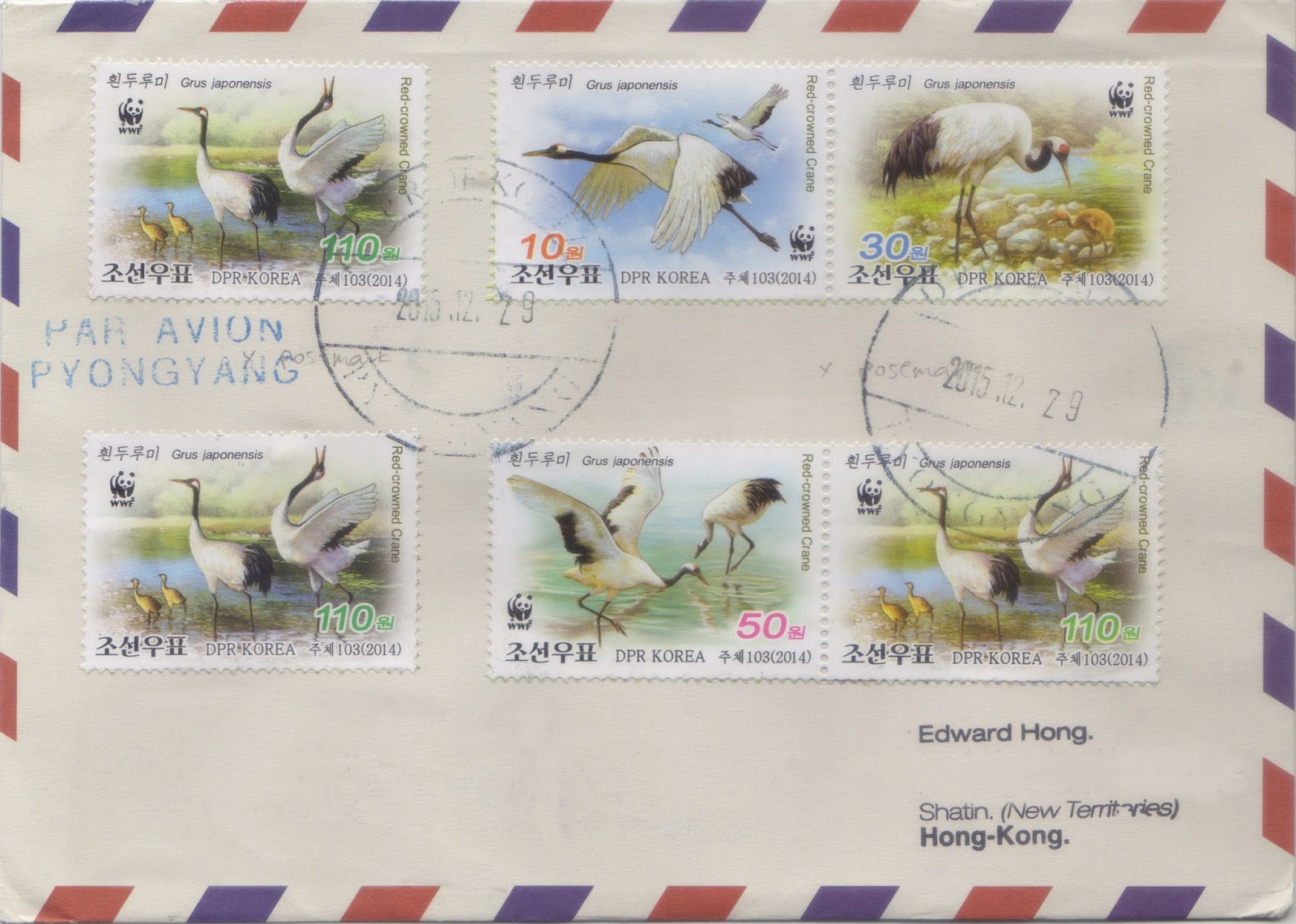
⭕️Red-crowned Crane

 
Red-crowned Crane (丹頂鶴)
North Korea (2014)

29th Deember, 2015. Pyongyang

Red-crowned Crane (丹頂鶴)
North Korea (2014)

30th May, 2016. Pyongyang
 
Red-crowned cranes are named for a patch of red bare skin on the crown, which becomes brighter in the mating season. Overall, they are snow white in color with black on the wing secondaries, which can appear almost like a black tail when the birds are standing, but the real tail feathers are actually white. Males are black on the cheeks, throat and neck, while females are pearly gray in these spots. The bill is olive green to greenish horn, the legs are slaty to grayish black, and the iris is dark brown.

This species is among the largest cranes, typically measuring about 150 to 158 cm tall and 120–150 cm in length (from bill to tail tip). Across the large wingspan, the red-crowned crane measures 220–250 cm. Typical body weight can range from 7 to 10.5 kg, with males being slightly larger and heavier than females and weight ranging higher just prior to migration. On average, it is the heaviest crane species, although both the sarus and wattled crane can grow taller and exceed this species in linear measurements. The maximum known weight of the red-crowned crane is 15 kg. Among standard measurements, the wing chord measures 56–67 cm, the exposed culmen measures 13.5–16.7 cm and the tarsus measures 25.5–30.1 cm.

16 April 2016

⭕️Black-browed Albatross

Black-browed Albatross (黑眉信天翁)
Pitcairn Islands (2014)
6th January, 2016. Pitcairn Islands

Black-browed Albatross, also known as the Black-browed Mollymawk, is a medium sized, pelagic albatross, at 80–95cm long with a 200–240cm wingspan and a weight of 2.9– 4.7kg. Living up to 70 years, its colouring is a dark grey upper with white underparts. The bill is orange-yellow and its unique dark eye-stripe gives it its name.

Black-browed Albatross breeds on 12 islands throughout the southern oceans. There are an estimated 1,220,000 birds alive with 600,000 breeding pairs (2005). Colonies are very noisy as they bray and cackle to mark their territory. The bird feeds on fish, squid, crustaceans, carrion and fishery discards. This species normally nests on steep slopes covered with tussock grass. They lay one egg which is incubated by both parents and after hatching, the chicks take 120 to 130 days to fledge.

Until 2013, the IUCN classified this species as "endangered" due to a drastic reduction in population and nesting sites. The overall situation is grim, with a 67% decline over 64 years. The Black-browed Albatross is the most common bird killed by fisheries through increased long line and trawl fishing in the southern oceans.

From left to right :
Wandering Albatross (漂泊信天翁) ; Black-browed Albatross (黑眉信天翁)
Buller's Albatross (新西蘭信天翁)
Pitcairn Islands (2014)
6th January, 2016. Pitcairn Islands

9 April 2016

Yellow-billed Stork

Yellow-billed Stork (黃嘴䴉鸛)
Gambia (2011)

9th December, 2015. Tranqueras

Yellow-billed stork, sometimes also called the wood stork or wood ibis, is a large African wading stork species in the Ciconiidae family. It is widespread in regions south of the Sahara and also occurs in Madagascar.

The yellow-billed stork is closely related to 3 other species in the Mycteria genus: the American woodstork (Mycteria americana), the milky stork (Mycteria cinerea) and the painted stork (Mycteria leucocephala). It is classified as belonging to one clade with these 3 other species because they all display remarkable homologies in behavior and morphology. In one analytical study of feeding and courtship behaviours of the wood-stork family, MP Kahl attributed the same general ethology to all members of the Mycteria genus, with few species-specific variations. These four species are collectively referred to as the wood-storks, which should not be confused with one alternative common name (wood-stork) for the yellow-billed stork.

Before it was established that the yellow-billed stork was closely related to the American woodstork, the former was classified as belonging to the genus Ibis, together with the milky stork and painted stork. However, the yellow-billed stork has actually long been recognised as a true stork and along with the other 3 related stork species, it should not strictly be called an ibis.

2 April 2016

⭕️Wetlands of Uruguay

Scarlet-headed Blackbird (猩紅頭黑雀)
Uruguay (2015)

5th June, 2015. Punta del Este

Snowy Egret (美洲雪鷺)
Uruguay (2015)
5th June, 2015. Punta del Este

The spotlight will shine on Uruguay's spectacular Bañados del Este y Franja Costera wetland when it hosts the 12th Meeting of the Conference of the Contracting Parties to the Ramsar Convention on Wetlands (COP12) in Punta del Este between 1-9 June.

The Bañados del Este y Franja Costera wetland is located on the eastern side of Uruguay, sharing a border with Brazil and taking in some of the country’s South Atlantic coast. An internationally recognised biosphere reserve, it comprises a vast complex of coastal wetlands, including various lagoons and parts of rivers. Altogether, these form a rich habitat for an assortment of wildlife, including myriad species that are categorised as near-threatened or endangered – one notable example is the juvenile green turtle (Chelonia mydas). Bañados del Este y Franja Costera was added to the Montreux Record, the register for wetlands where ecological changes have occurred or are occurring because of human interference, in July 1990. The area had already been designated as a wetland of international significance in 1984, thereby coming under the auspices of the Convention on Wetlands (or Ramsar Convention) which is committed to the conservation of vulnerable wetlands while achieving sustainable development by delivering a framework action at local and global levels.

The Bañados del Este y Franja Costera wetland is situated in the departments of Rocha and Treinta y Tres in eastern Uruguay (its coordinates are: 33°48'S 053°50'W). The site covers an approximate area of some 407,408 hectares. Many of the country’s rivers flow east toward the Atlantic and empty into lagoons in the coastal plain – the largest of these is Laguna Merin, Uruguay’s easternmost destination and part of the reserve.

26 March 2016

⭕️Isla de Flores

Snowy Egret (美洲雪鷺), Kelp Gull (黑背鷗) and
American Oystercatcher (美洲蠣鷸)
Uruguay (2011)

3rd December, 2015. Montevideo

Isla de Flores is a small island in the Rio de la Plata, 21 miles south-east of Punta Carretas, Montevideo, Uruguay.

Flores was named by Sebastián Gaboto, who discovered it on Easter Sunday 1527 (the Spanish expression Pascua Florida or Pascua de Flores, i.e. "Flowery Easter" was the reason for the name "Flores").

It has a historic lighthouse, which was the subject of an 1819 treaty, by which Uruguay lost the Misiones Orientales. This lighthouse, of Portuguese origin, entered service in 1828. It was dubbed "the world's most expensive lighthouse".[by whom?] The lighthouse is now under the jurisdiction of the Uruguayan Navy. It is 37 metres high and flashes twice every 10 seconds.